

Blog
Tint Meter vs. Visual Estimation: Why Officers Shouldn't Eyeball Window Tint
Quick answer
Window tint is regulated by a number, Visible Light Transmission (VLT), and an estimate by eye cannot produce a number you can verify, repeat, or document. A police tintmeter measures VLT directly: Tint-Chek meters read at 550 nanometers with a stated accuracy of +/- 2 percentage points and repeatability of 1 percentage point, and the test takes about 2 seconds on the one-piece models. An officer's eye can flag a window worth checking. The tint meter is what measures it.
Scope note: whether an officer's visual impression can support a stop or a citation, and what the legal VLT limit is, depends on your state. This article does not give legal advice. Confirm with your agency or prosecutor.
What does a police tint meter measure?
A tint meter (also called a tint tester) measures the percentage of visible light that passes through automotive glass and any film applied to it. Tint-Chek meters use an LED light source at a wavelength of 550 nanometers, across a 0 to 100% range, on glass or glass/film up to 1/4 inch (6.5 mm) thick.
That output is a percentage. It is the same kind of value that tint rules are written in, so a meter reading speaks the same language as the standard it is compared to.
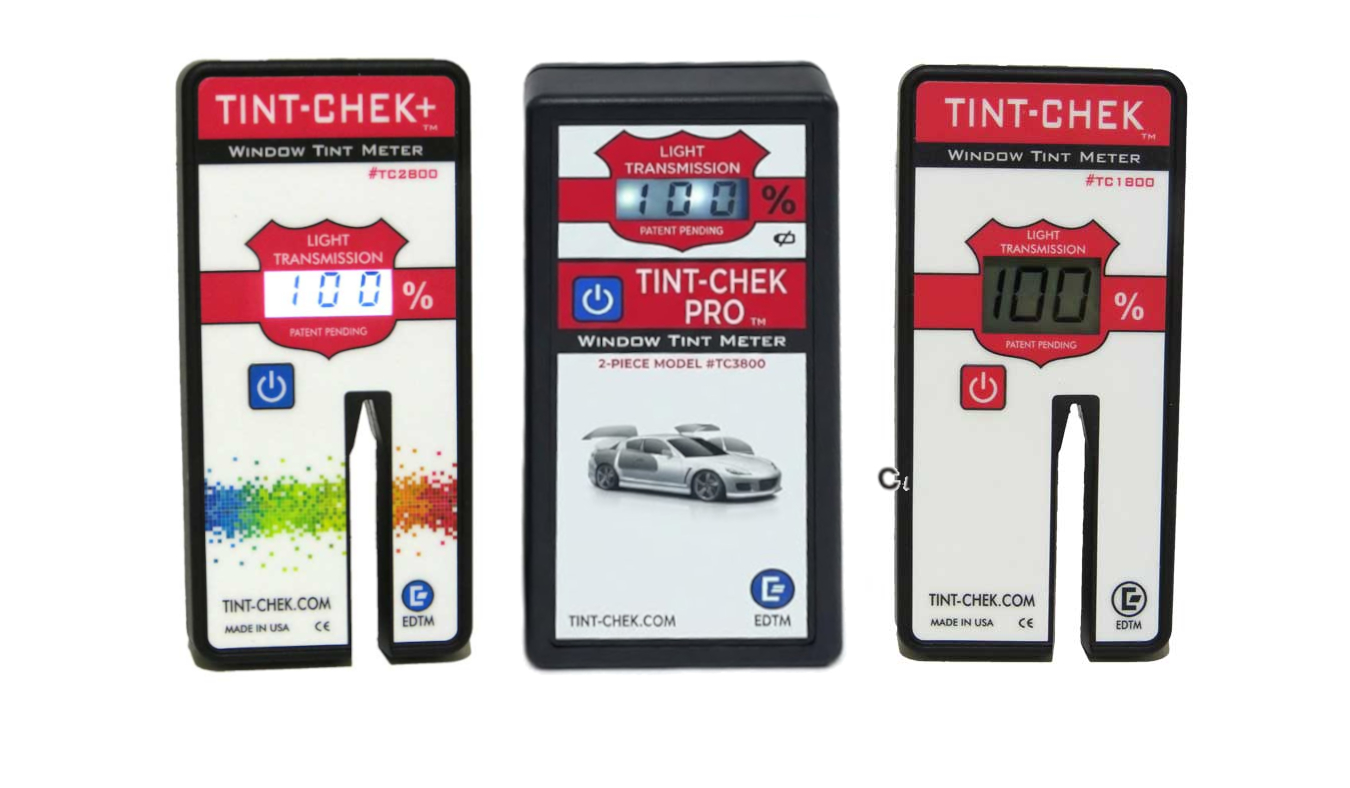
Why is estimating tint by eye a weak basis for a decision?
The points below are reasoning, not measurement data. They explain why an estimate and a reading are different kinds of evidence.
• It is a judgment, not a measurement. Two officers can look at the same window and describe it differently. A meter reads one value.
• There is nothing to check it against. A tint meter can be verified with two NIST-traceable calibration standards. An estimate has no standard to be verified against.
• It cannot be repeated on demand. A meter's repeatability is rated at 1 percentage point. A visual impression has no stated repeatability.
• It leaves little to record. A meter shows a number you can write down and confirm with a second test. An estimate leaves a description.
• Close calls are the hard part. A window near the legal limit is exactly where a few percentage points matter, and where an eyeball judgment is least reliable.
What does a tint meter add that an estimate cannot?
|
|
Estimate by eye |
Tint-Chek tint meter |
|
Output |
A personal judgment |
A VLT percentage on a digital display |
|
Measurement basis |
None stated |
550 nm, LED light source |
|
Stated accuracy |
None |
+/- 2 percentage points |
|
Stated repeatability |
None |
1 percentage point |
|
Verification |
No standard to check against |
Two NIST-traceable calibration standards (about 27% and 59% VLT), verified to within +/- 2% |
|
Confirming test |
Another look |
Re-test the window (manual step 5) |
|
Test time |
Varies |
About 2 seconds (TC1800 and TC2800) |
|
Record |
A description |
A displayed value, plus a log of the meter's verification |
Does lighting change what a tint meter reads?
It can affect older meters. According to the Tint-Chek product pages, stray headlights and cloud cover have been known to hurt the performance of older VLT meters. Tint-Chek meters use patent-pending technology to remove ambient light conditions that may change in the testing environment. The meter also calibrates itself at start-up and monitors its calibration while measuring.
How do officers take the reading?
For the one-piece Tint-Chek meters (TC1800 and TC2800), the quick-start directions are short:
1. Roll the window down at least 3 inches.
2. Clean the glass.
3. Turn the meter on and wait for the display to read 100%.
4. Slide the meter over the edge of the glass and read the result.
5. Re-test the window to confirm the first reading.
For the two-piece TC3800 Tint-Chek PRO, which also tests windshields: set the two units back-to-back to register 100%, place the reflector unit on the inside of the window and the instrument unit on the outside, then press the power switch to see the VLT value. Repeat to confirm.
Keep the meter's calibration standards clean and verify the meter against them on a regular basis, following your agency's policy.
Can a tint tester work alongside an officer's eye?
Yes, and that is the practical answer. An officer's eye may spot a window that looks dark. That is a reason to measure, not the measurement itself. The reading is what can be confirmed with a second test, checked against the calibration standards, and written into a report.
Which Tint-Chek car tint meter fits law enforcement?
Tint-Chek tint meters are designed for law enforcement, police, and tinters, and are made in the USA. Each includes a protective carrying case, two NIST-traceable calibration standards, and a 9-volt battery.
|
|
TC1800 |
TC2800 |
TC3800 PRO |
|
Design |
One-piece |
One-piece |
Two-piece |
|
Windows tested |
Side |
Side |
Windshield, rear, side |
|
Resolution |
1% |
0.1% |
0.1% |
|
Backlit display |
No |
Yes |
Yes |
|
List price |
$105.00 |
$139.00 |
$229.00 |
• 0.1% resolution (TC2800 and TC3800). A 39.5% window shows as 39.5%, not rounded to 40% as on a whole-number display like Brand X-style budget meters.
• Backlit display (TC2800 and TC3800). Windows can be tested at night, on overcast days, or indoors.
• No mechanical lever switch. The one-piece meters have no moving parts, which means nothing to scratch the glass.
• Pocket size. The TC1800 and TC2800 are about 5.2 x 2.5 x 1 inches and weigh 0.34 lb.
To talk through which model fits your agency, visit tint-chek.com or call (419) 861-1030.
Frequently asked questions
Can an officer estimate window tint by eye?
An officer can form a visual impression, but it is not a measurement. Whether it can support a stop or citation depends on your jurisdiction, so check with your agency or prosecutor. A car tint meter gives a VLT number you can document and confirm.
How accurate is a police tint meter?
Tint-Chek meters list accuracy of +/- 2 percentage points and repeatability of 1 percentage point. You can verify a meter with the two NIST-traceable calibration standards that come with it.
How long does a tint meter test take?
The TC1800 and TC2800 list a testing time of 2 seconds. The manual for the two-piece TC3800 does not list a testing time. Its test is to register 100% with the units back-to-back, place the two units on the window, and press the power switch to view the VLT value.
What is the difference between a tint meter and a tint tester?
The terms are used interchangeably. Both measure Visible Light Transmission through automotive glass and film.
Which car tint meter can test a windshield?
The two-piece Tint-Chek PRO (TC3800). The TC1800 and TC2800 are one-piece meters for side windows.