

Blog
7 Common Tint Meter Mistakes Officers Make (And How to Avoid Them)
Quick answer
Most bad tint readings come from a handful of avoidable habits: testing dirty glass, tilting the meter, powering on with glass already in the opening, not seating the meter fully, skipping the re-test, and not verifying the meter against its calibration standards. A Tint-Chek police tint meter is built to make the test fast, about 2 seconds on the TC1800 and TC2800, but the steps in the manual still matter. This guide walks through seven mistakes and the fix for each, using only what the Tint-Chek manuals say.
Scope note: this article covers equipment use. Legal VLT limits and evidence rules vary by state, so confirm those with your agency or prosecutor.
What is a tint meter, and what does it measure?
A tint meter, also called a tint tester or tint gauge, measures Visible Light Transmission (VLT): the percentage of light that passes through automotive glass and any film on it. Tint-Chek meters measure at 550 nanometers with an LED light source, across a 0 to 100% range, and list accuracy of +/- 2 percentage points and repeatability of 1 percentage point. Those specifications only hold if the test is done properly, which is what the seven mistakes below are about.
Mistake 1: Testing glass that has not been cleaned
What goes wrong: The manuals warn that fingerprints, dirt, and defects on the glass can affect the transmission values. A smudge on the glass is read by the tint meter as part of the window.
The fix: Clean the glass first. It is step 2 of the quick-start directions on the TC1800 and TC2800, and step 1 on the TC3800 ("Clean the window area being tested").
Mistake 2: Not rolling the window down far enough
What goes wrong: The one-piece meters (TC1800 and TC2800) slide over the edge of the glass, and the quick-start directions call for at least 3 inches of open window.
The fix: Roll the window down at least 3 inches before testing, and check the gap before you slide the meter on.
Mistake 3: Turning the meter on with glass already in the opening
What goes wrong: At start-up, the meter calibrates itself and reads 100%. According to the manual, if you power it on with glass already in position, the display will calibrate to read 100% with that glass in place. Your baseline is then the glass, not open air.
The fix: Power the meter on with nothing in the opening, and wait for 100% before sliding it onto the glass. If you make this mistake, remove the meter from the glass. The display shows "-E" and powers off. Turn it back on with nothing in the opening and it will show 100%.
Mistake 4: Tilting the meter or the glass
What goes wrong: The manual says that for the most accurate transmission measurements the glass should be held perpendicular to the sensor, and not to tilt the meter or glass at angles.
The fix: Keep the meter square to the glass. Slide it straight on, and do not twist or angle it while reading.
Mistake 5: Not seating the meter fully, or testing the extreme edge
What goes wrong: If the edge of the glass is blocking the sensor, or if you test the extreme edge of a window where film may not cover the whole pane, the reading can be off. The manual notes that testing on the extreme edge can negatively affect accuracy because of the edges of the window film.
The fix: Slide the meter completely onto the glass until it presses against the stop location and clamps in the meter opening. The manual says this avoids both problems. Also note where on the window you tested.
Mistake 6: Skipping the confirming re-test
What goes wrong: A single reading cannot show whether the first placement was good. The manufacturer builds a confirming test into the directions.
The fix: Re-test the window to confirm the first reading. That is step 5 of the TC1800 and TC2800 quick-start directions. On the TC3800, the instructions say to repeat the process from step 1 to confirm. The stated repeatability for all three models is 1 percentage point, so a confirming reading should land close to the first.
Mistake 7: Letting verification slide
What goes wrong: A meter that has drifted, or standards that are dirty or scratched, can produce readings nobody has checked. The manuals say you should verify the meter against its calibration standards "on a regular basis," though they do not specify an interval.
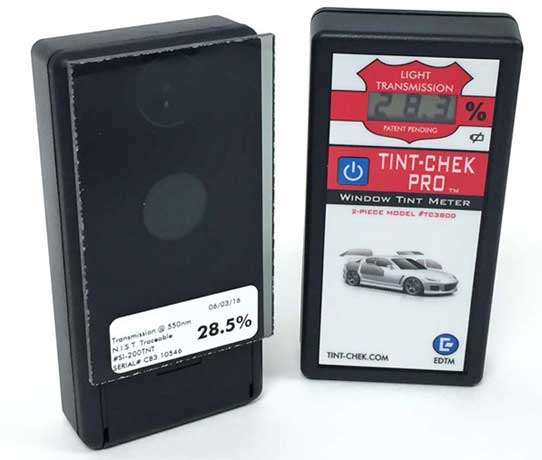
The fix: Every Tint-Chek meter comes with two NIST-traceable calibration standards of approximately 27% and 59% VLT. Verify that the meter reads each within +/- 2% of its indicated value, after cleaning the standards. If the meter reads outside that range, inspect the standards first. If they are in good condition, the manuals say to stop using the meter until calibration is verified or corrected. Set the interval by agency policy, and log each check (date, standard, reading, pass or fail, who checked).
Bonus: extra pitfalls with the two-piece TC3800
The Tint-Chek PRO has a reflector unit and an instrument unit, so it has a few extra steps.
• Misalignment at start-up. Put the two units back-to-back with no glass between them, let the magnets align them, and wait for 100% before pulling them apart. Misalignment at start-up can trigger error codes: E1 (reading less than allowed), E2 (reading greater than allowed), or E3 (start-up value different than expected). The fix for each is to turn the unit off, align it with the reflector, turn it on, and run a new test.
• A dirty reflector. Keep the reflector area clean. Use compressed air for dust, and a micro-fiber cloth for smudges.
• Suction cups on defrost lines. On rear windows, cups will not stick on the defrost lines. If you cannot find a spot that misses them, rotate the reflector unit 90 degrees.
• Storing the meter in the vehicle. The manual does not recommend storing the instrument in your automobile overnight during extreme temperature seasons. The listed operating range for all three models is 0 F to 122 F (-17 C to +50 C), and storage is -4 F to 158 F (-20 C to +70 C).
• A low battery. The TC1800 and TC2800 scroll "-battery-" across the screen when the battery is getting low. The meter can still be used, but replace the battery soon. The TC3800 illuminates a battery indicator.
Which Tint-Chek tint meter helps officers avoid these mistakes?
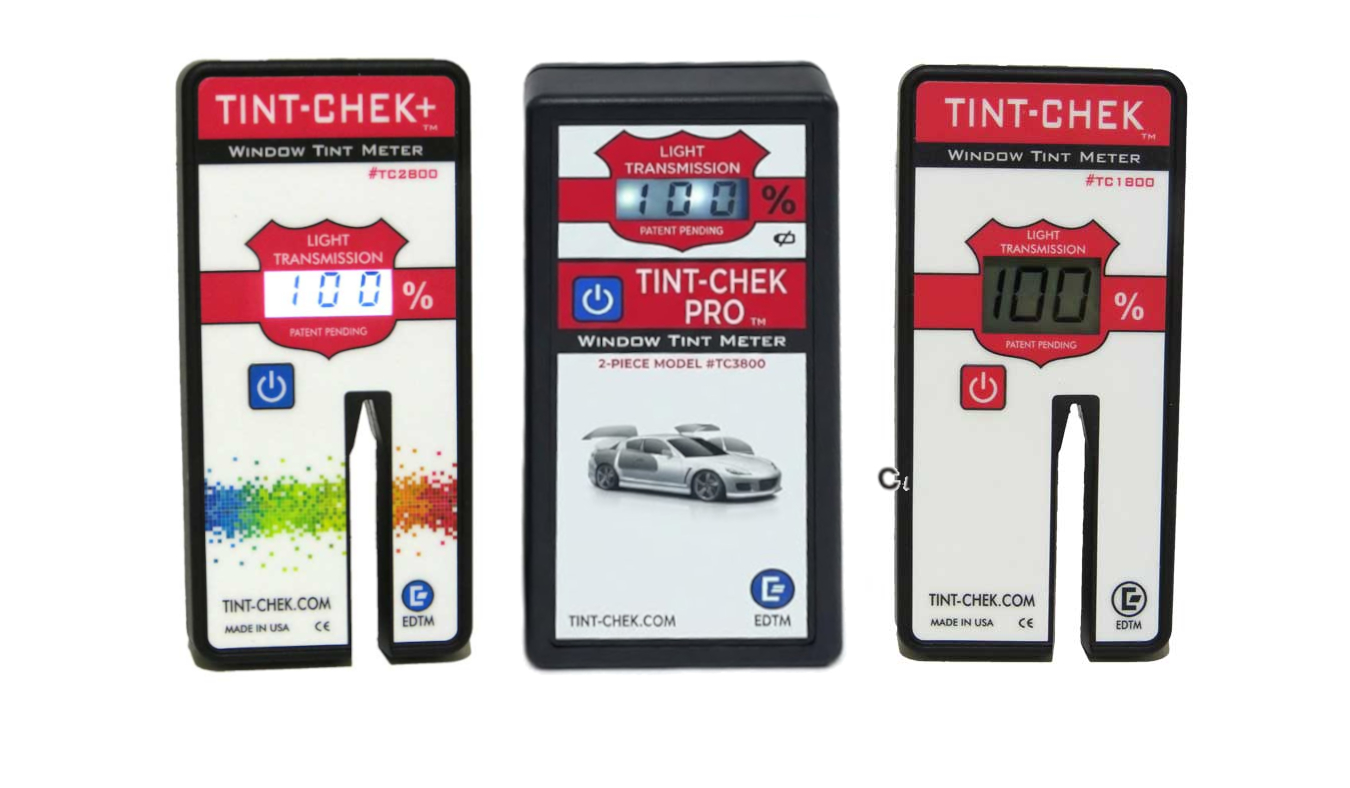
Tint-Chek tint meters are designed for law enforcement, police, and tinters, and are made in the USA. All three include a protective carrying case, two NIST-traceable calibration standards, and a 9-volt battery.
|
|
TC1800 |
TC2800 |
TC3800 PRO |
|
Design |
One-piece |
One-piece |
Two-piece |
|
Windows tested |
Side |
Side |
Windshield, rear, side |
|
Resolution |
1% |
0.1% |
0.1% |
|
Backlit display |
No |
Yes |
Yes |
|
List price |
$105.00 |
$139.00 |
$229.00 |
Features that help prevent mistakes:
• No mechanical lever switch. The one-piece meters have no moving parts, so you can slide the glass into the opening in any direction without scratching it. Brand X-style lever meters activate when pushed against the glass.
• Auto-calibration at start-up and continuous monitoring. The meter monitors its calibration during measurements and resets itself between measurements if it detects a problem.
• Ambient light removal. Patent-pending technology removes ambient light conditions that can change in the testing environment, such as stray headlights and cloud cover, per the product pages.
• Backlit display (TC2800 and TC3800). Easier reading at night, on overcast days, or indoors.
• Automatic power-off. The one-piece meters shut off after about 2 minutes if not used.
To discuss which model fits your agency, visit tint-chek.com or call (419) 861-1030.
Frequently asked questions
What is the most important step when using a tint meter?
There is no single step. The manuals build accuracy from several: clean the glass, start the meter with nothing in the opening, hold the glass perpendicular to the sensor, seat the meter fully, and re-test.
How do I know my tint tester is accurate?
Measure the two included calibration standards (approximately 27% and 59% VLT). The reading on each should be within +/- 2% of its indicated value.
What does "-E" mean on a Tint-Chek display?
On the TC1800 and TC2800, "-E" means something is between the LED source and the sensor, or the meter was turned on with glass in the opening. Remove the obstruction, then turn the meter back on with nothing in the opening.
Can a police tint meter test a windshield?
The two-piece Tint-Chek PRO (TC3800) is designed to test windshield, rear, and side windows. The TC1800 and TC2800 are one-piece meters for side windows.
Why should I re-test a window?
The manufacturer's directions include a confirming re-test so you can check the accuracy of your first reading. Repeatability is rated at 1 percentage point on every model.