

Blog
Tint Meter Evidence in Court: Calibration Records, Admissibility, and Officer Testimony Explained
Quick answer
A tint meter reading holds up best when three things are documented: the meter was verified against known standards, the officer followed the manufacturer's procedure, and the reading was recorded and re-tested. A Tint-Chek digital tint meter ships with two NIST-traceable calibration standards (approximately 27% and 59% VLT), so any officer or inspector can verify the meter to within +/- 2% of the indicated values and keep a record of it.
Scope note: whether a reading is admissible, and what the legal VLT limit is, depends on your state and court. This article covers the equipment, records, and procedure side. It does not cite statutes or case law. Confirm legal requirements with your prosecutor, agency counsel, or attorney.
What does a tint meter measure, and why does it matter in court?
A tint tester (also called a tint meter) measures Visible Light Transmission (VLT): the percentage of light that passes through automotive glass and any film applied to it. Tint-Chek digital tint meters measure at a wavelength of 550 nanometers using an LED light source, across a 0 to 100% range, on glass or glass/film up to 1/4 inch (6.5 mm) thick.
In a tint citation, the VLT number is the evidence. That makes the meter's condition, its verification history, and the method used to take the reading the three things most likely to be examined.
What calibration records should back up a tint meter reading?
A complete record answers one question: how do we know this meter was reading correctly when it was used?
Factory calibration. Tint-Chek meters come from the factory calibrated to a NIST (National Institute of Standards and Technology) traceable standard.
Included verification standards. Every Tint-Chek meter includes two NIST-traceable calibration standards with VLT values of approximately 27% and 59%. The actual calibrated value of each standard is printed on its label (TC1800 and TC2800) or on the sample itself (TC3800).
The verification rule. Per the user manuals, the meter should read each standard within +/- 2% of its indicated value. The manuals say to verify "on a regular basis" but do not set a fixed interval, so set your interval by agency policy.
If a reading falls outside +/- 2%. Inspect the standards first: clean, unscratched, free of dust and fingerprints. If the standards are in good condition, the manuals say to stop using the meter until calibration is verified or corrected. For the TC3800, also check the reflector area and blow off the back of the instrument unit with compressed air, then contact the manufacturer if the problem persists.
Replacement standards. TC1810 covers the TC1800 and TC2800. TC3811 covers the TC3800. Both are NIST-traceable replacement sets listed at $20.00.
Suggested calibration log fields
The manuals describe how to verify a meter. They do not prescribe a log format. The fields below are a practical suggestion, not a manufacturer requirement.
|
Field |
Why it matters |
|
Meter model and serial number |
Ties the record to one instrument |
|
Date and time of verification |
Shows the meter was checked before use |
|
Standard labeled value (about 27% / about 59%) |
The reference the meter is compared to |
|
Meter reading on each standard |
Shows the result |
|
Pass/fail against +/- 2% |
Documents the manuals' criterion |
|
Standards condition (clean, unscratched) |
The manuals require this before verification |
|
Name of person who verified |
Establishes who can testify |
Is a tint meter reading admissible in court?
That is a legal question, and the answer depends on jurisdiction, so we won't state a rule that may not apply to you. What the equipment side can give you is the foundation material a court may ask about:
• The meter model and its published specifications
• Evidence of factory calibration to a NIST-traceable standard
• A dated record of verification against the included standards
• The procedure followed, matching the manufacturer's instructions
• The reading, and a confirming re-test
Tint-Chek meters are listed as Approved for Law Enforcement (TC1800, TC2800) and Approved for Law Enforcement & Inspection Stations (TC3800) on their product pages. Check your own state's or agency's approval requirements, since that listing does not replace them.
What should an officer be ready to testify about?
Officer testimony is strongest when it follows the manufacturer's steps and each step is documented. Here is the sequence, by model.
One-piece meters (TC1800 and TC2800)
1. Roll the window down at least 3 inches.
2. Clean the glass. Fingerprints, dirt, and defects can affect transmission values.
3. Turn the meter on and wait for the display to read 100%, which means it has self-calibrated and is ready.
4. Slide the meter over the edge of the glass, fully onto the stop location, with the glass held perpendicular to the sensor (no tilting).
5. Read the display.
6. Re-test the window to confirm the first reading.
Two details worth noting in a report: the manuals warn that testing on the extreme edge of a window can affect accuracy where film does not cover the whole pane, and that sliding the meter fully on until it clamps avoids that problem. The test takes about 2 seconds.
Two-piece meter (TC3800 Tint-Chek PRO)
1. Clean the window area being tested.
2. Put the two units back-to-back with no glass between them and turn the power on.
3. Wait for 100%, then pull the halves apart.
4. Place the reflector unit on the inside of the window and push it firmly so the suction cups hold.
5. Place the instrument unit on the exterior, letting the magnets align it.
6. Press and release the power switch to view the VLT value.
7. Remove the instrument. It powers off automatically. Repeat from step 1 to confirm.
On rear windows, suction cups will not stick on defrost lines. The manual says to rotate the reflector unit 90 degrees to place both cups between the lines.
Facts an officer may want on record
• Meter model and serial number
• Date, time, and result of the most recent standards verification
• Which window was tested and where on the glass
• Whether the glass was cleaned first
• The reading and the confirming re-test reading
• Any error codes shown (see below)
How accurate is a digital tint meter?
All three Tint-Chek models list the same accuracy and repeatability specifications, taken from the manuals:
|
Specification |
TC1800 |
TC2800 |
TC3800 |
|
Accuracy |
+/- 2 percentage points |
+/- 2 percentage points |
+/- 2 percentage points |
|
Repeatability |
1 percentage point |
1 percentage point |
1 percentage point |
|
Display resolution |
1% |
0.1% |
0.1% |
|
Wavelength |
550 nm |
550 nm |
550 nm |
|
Measurement range |
0 to 100% |
0 to 100% |
0 to 100% |
|
Operating temperature |
0 F to 122 F (-17 C to +50 C) |
0 F to 122 F (-17 C to +50 C) |
0 F to 122 F (-17 C to +50 C) |
Resolution and accuracy are different things. Resolution is how finely the display shows a reading. Accuracy is how close the reading is to the true value. The 0.1% display on the TC2800 and TC3800 avoids rounding. For example, a 39.5% VLT window is shown as 39.5% instead of being rounded to 40% on a whole-number display, such as the kind found on Brand X-style budget meters. The +/- 2 point accuracy specification still applies to every model, and your records should reflect that.
The Tint-Chek line also uses patent-pending technology to remove ambient light. Stray headlights and cloud cover have been known to affect older VLT meters, according to the product pages.
What do the error codes mean, and how do they affect a test record?
A documented error and a documented re-test are better than a silent do-over.
• TC1800 and TC2800 "-E": Something is between the LED source and the sensor, or the meter was turned on with glass already in the opening. Remove the glass or obstruction, turn it back on with nothing in the opening, and wait for 100%.
• TC3800 E1: The measured VLT is less than the allowed percentage. Often caused by misalignment at start-up, measuring without glass, or holding the unit away from the glass.
• TC3800 E2: The measured VLT is greater than the allowed percentage. Often caused by misalignment at start-up or starting against a different surface than the reflector.
• TC3800 E3: The 100% start-up value was different than expected. Align the two enclosures properly and clean the reflector lens with compressed air or a micro-fiber cloth.
For E1, E2, and E3, the manual's fix is the same: turn the unit off, align it with the reflector with no glass between, turn it on, and run a new test.
Which Tint-Chek tint meter fits law enforcement use?
Tint-Chek tint meters are designed for law enforcement, police, and tinters, and are made in the USA (listed as 100% Made in the USA). All three include a protective carrying case, two NIST-traceable calibration standards, and a 9-volt battery.
|
|
TC1800 Tint-Chek |
TC2800 Tint-Chek + |
TC3800 Tint-Chek PRO |
|
Design |
One-piece |
One-piece |
Two-piece (reflector + instrument) |
|
Windows tested |
Side windows |
Side windows |
Windshield, rear, and side |
|
Resolution |
1% |
0.1% |
0.1% |
|
Backlit display |
No |
Yes |
Yes |
|
Best for |
Side-window testing at the lowest list price |
Night, overcast, and indoor testing with finer resolution |
Full-vehicle testing including windshield |
|
Dimensions |
5.2 x 2.5 x 1 in |
5.2 x 2.5 x 1 in |
5.1 x 2.6 x 2.0 in |
|
Weight |
0.34 lb (0.15 kg) |
0.34 lb (0.15 kg) |
0.78 lb (0.35 kg) |
|
Replacement standards |
TC1810 |
TC1810 |
TC3811 |
|
List price |
$105.00 |
$139.00 |
$229.00 |
Prices are the single-unit list prices on the product pages at time of writing, with volume discounts at 5 and 10 units. Confirm current pricing before publishing.
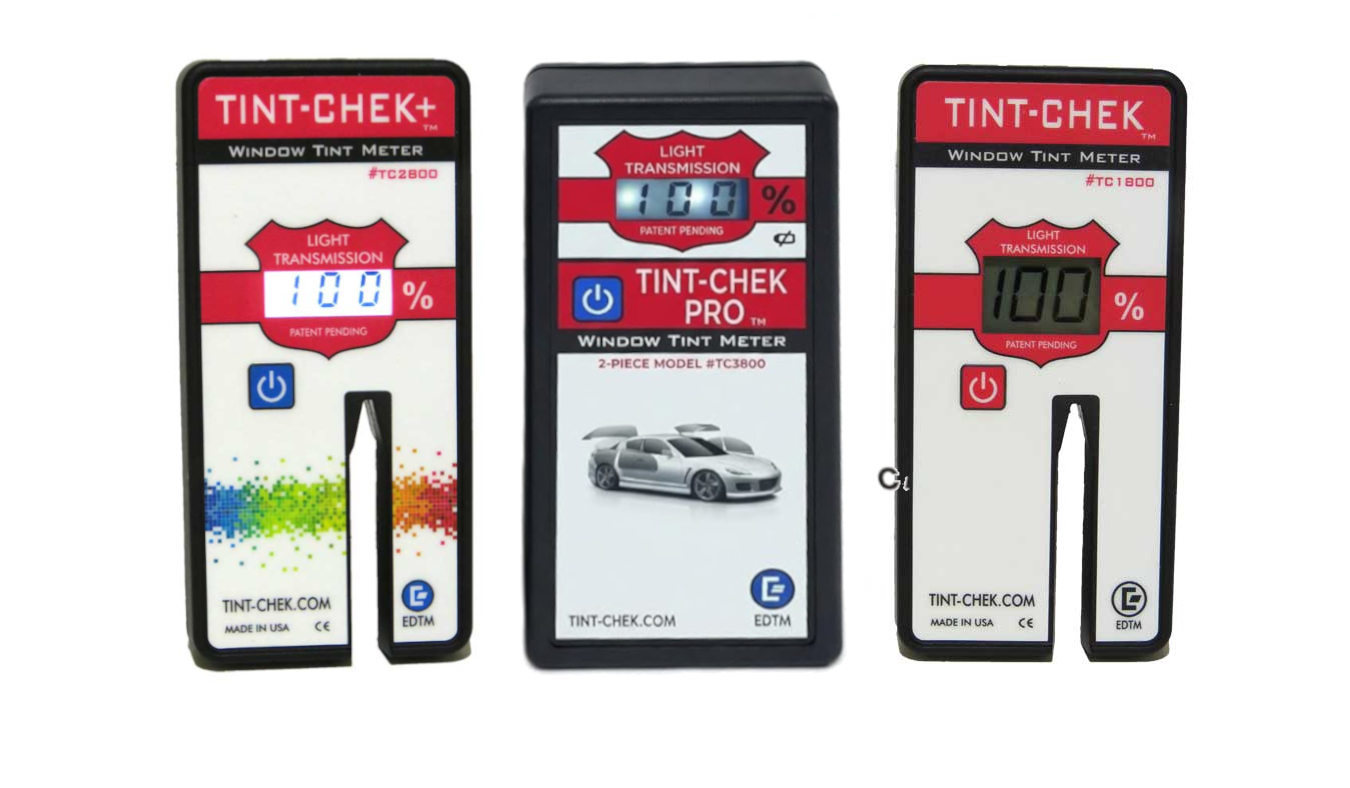
Why Tint-Chek over Brand X. Based on the product pages:
• No mechanical lever switch. The one-piece meters have no moving parts. Brand X-style lever meters activate when pushed against the glass, which is a point of wear and a risk of scratching the glass.
• Backlit display. The TC2800 and TC3800 can be read at night, which most competing models do not offer.
• Pocket size. The TC1800 and TC2800 are about 5.2 x 2.5 x 1 inches. The product pages say many existing models are as large as 6 x 3.5 x 1.5 inches.
• Larger display. The TC1800 display is 35% larger than competing models, per its manual.
• Slide-out battery cover (TC3800). No screws to remove, so no risk to your calibration when changing the battery. The product page notes competing models need screws removed and a non-standard screwdriver.
• Warranty. 12 months from original ship date, covering defects in material and workmanship. Batteries are not covered, and the warranty does not apply to units repaired or altered by anyone other than the manufacturer.
To talk through which model fits your agency or shop, visit tint-chek.com or call (419) 861-1030.
Frequently asked questions
What is the difference between a tint meter and a tint tester?
The terms are used interchangeably. Both measure Visible Light Transmission (VLT) through automotive glass and film. Tint-Chek digital tint meters display the result as a percentage.
How do I verify a digital tint meter is accurate?
Measure the two calibration standards that come with the meter (approximately 27% and 59% VLT). The reading on each should be within +/- 2% of the value indicated on the standard. Clean the standards first and record the results.
Can a tint meter reading be challenged in court?
Any measurement can be questioned. The strongest response is documentation: the meter model, factory NIST-traceable calibration, a dated verification against the included standards, the procedure followed, and a confirming re-test. Admissibility rules vary by jurisdiction, so consult your prosecutor or counsel.
Which police tint meter can test a windshield?
The Tint-Chek PRO (TC3800) is the two-piece model designed to test windshield, rear, and side windows. The TC1800 and TC2800 are one-piece meters for side windows.
How often should a tint meter be calibrated?
The manuals say to verify the meter against the included standards "on a regular basis" but do not give a specific interval. Follow your agency's policy. If a reading falls outside +/- 2% and the standards are in good condition, stop using the meter until calibration is verified or corrected.