

Blog
How Accurate Is a Police Tint Meter?
Tint-Chek police tint meters are accurate to ±2 percentage points, according to the TC1800, TC2800, and TC3800 manuals. Each meter comes from the factory calibrated to a NIST traceable standard, and officers can verify it with the two calibration standards that come with it. Repeatability is listed at 1 percentage point.
What accuracy do Tint-Chek police tint meters list?
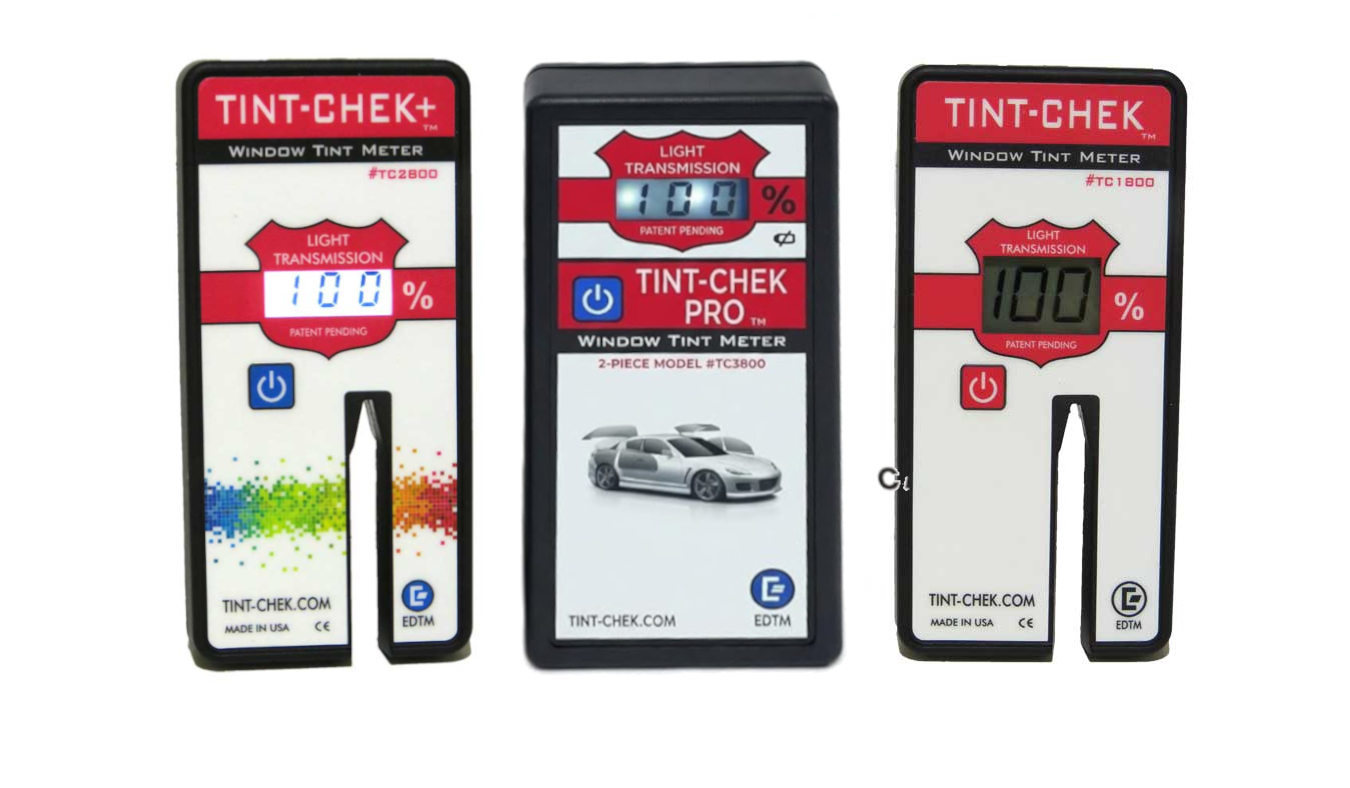
The manuals for the Tint-Chek line, including the compact tint gauge for law enforcement (TC1800), list the same accuracy and repeatability for all three models:
|
Specification |
TC1800 |
TC2800 |
TC3800 |
|
Accuracy |
±2 percentage points |
±2 percentage points |
±2 percentage points |
|
Repeatability |
1 percentage point |
1 percentage point |
1 percentage point |
|
Display resolution |
1% |
0.1% |
0.1% |
|
Measurement range |
0 to 100% |
0 to 100% |
0 to 100% |
|
Calibration |
Factory calibrated, NIST traceable |
Factory calibrated, NIST traceable |
Factory calibrated, NIST traceable |
What does ±2 percentage points mean?
It means a reading can differ from the actual VLT by up to 2 percentage points in either direction. For example, a tint tester reading of 35% means the actual VLT falls between 33% and 37%. Your department's policy and local law decide how readings near a limit are handled.
Does a 0.1% display make a police tint meter more accurate?
The accuracy specification is ±2 percentage points on all three meters. The difference is display resolution, which is how finely the meter shows a reading. The TC2800 and TC3800 show the nearest 0.1%, so a window at 39.5% VLT appears as 39.5% instead of 40%. The backlit LCD on the police tint tester (TC2800) and the TC3800 also makes the reading easier to see in the evening or indoors.
How do officers verify a police tint meter?
Every Tint-Chek comes with two calibration standards, with VLT values of approximately 27% and 59%. The actual value is printed on each standard. To verify a tint gauge, measure each standard and check that the reading is within ±2% of its indicated value. The manuals say to do this on a regular basis.
• Make sure the standards are clean and not scratched before you measure them.
• If the meter reads outside ±2%, inspect the quality of the calibration standards.
• If the standards are in great condition, stop using the meter until the calibration can be verified or corrected.
• For the TC3800, also check that the reflector area is clean, and contact the manufacturer if problems still exist.
What can affect the accuracy of a tint reading?
• Dirty glass. Fingerprints, dirt, and defects on the glass can affect the transmission values.
• Tilting. For the most accurate measurements, hold the glass perpendicular to the sensor. Do not tilt the meter or the glass.
• The window edge. Testing on the extreme edge of the window can negatively affect the result because of the edges of window film.
• Changing light. Patent-pending techniques remove ambient light conditions that change in the testing environment.
Is a police tint meter calibrated before use?
Yes. Tint-Chek meters come from the factory calibrated to a NIST traceable standard, and they self-calibrate each time you turn them on. The TC1800 and TC2800 also continually monitor their calibration during measurements and reset themselves if they detect a problem.
Frequently asked questions
What is the accuracy of the TC1800?
The TC1800 manual lists accuracy of ±2 percentage points and repeatability of 1 percentage point. It displays readings to the nearest 1%.
What is the accuracy of the TC2800?
The TC2800 manual lists accuracy of ±2 percentage points and repeatability of 1 percentage point. It displays readings to the nearest 0.1%.
What is the accuracy of the TC3800?
The TC3800 manual lists accuracy of ±2 percentage points and repeatability of 1 percentage point. It displays readings to the nearest 0.1%.
What does repeatability mean?
Repeatability is how closely repeat readings of the same window agree. The Tint-Chek manuals list it as 1 percentage point.
What does NIST traceable calibration mean?
NIST is the National Institute of Standards and Technology, a government standards agency. Tint-Chek meters come from the factory calibrated to a NIST traceable standard, and the calibration standards that come with them were created using a NIST traceable source.
How often should officers verify a tint meter?
The manuals say to verify the meter on a regular basis. Several published agency policies set their own schedule, so follow your department's policy.
Do headlights or cloud cover change a car tint meter reading?
Changing ambient light has been known to affect older VLT meters. Tint-Chek meters use patent-pending techniques to remove ambient light conditions that change in the testing environment.
Can an officer re-test a window?
Yes. The TC1800 and TC2800 quick-start guides end with a step to re-test the window to confirm the first test. The TC3800 guide says to repeat the process to confirm the previous measurement.
Choose a police tint meter
For windshield, rear window, and side window testing, see the car tint meter for police officers in the Tint-Chek line, the two-piece TC3800 PRO.