

Blog
Window Tint Violations: How Officers Can Build a Stronger Citation Every Time
A tint stop can end with a dismissed ticket if the measurement cannot be explained. The officer may be right about the violation, but if the reading was taken carelessly or not documented, the case gets weaker. A strong window tint citation depends on three things: knowing the statute, taking a clean reading, and recording how you got it.
This guide covers a practical process for officers using a tint meter for law enforcement, from checking the meter before your shift to writing the report. Always follow your agency’s policy and your prosecutor’s guidance, since requirements differ by state and department.
Key Takeaways
• A defensible tint citation rests on the right statute, a verified meter, a clean reading, and complete documentation.
• Check the meter against its 27% and 59% standards (within plus or minus 2%) and log the check.
• Re-test the window to confirm the first reading, and record the model, reading, and window tested.
• Follow your agency’s policy and your prosecutor’s guidance on documentation and tolerance.
Start With the Statute, Not the Stop
Window tint violations are defined by state law, and the limits differ for the windshield, front side windows, rear side windows, and rear window. Some states also treat vehicle types differently and regulate reflectivity and color. Before you cite, be sure which window you are measuring and which legal limit applies to it. Keep a current reference for your state, and confirm it against the statute text, since states revise their limits.
Verify Your Meter Before You Use It
Your reading is only as credible as your meter. Tint-Chek meters ship with two light transmission standards at approximately 27% and 59% VLT, created using a NIST traceable source, with the actual calibrated value printed on each standard.
1. Clean the standards. Blow off dust and remove fingerprints with a lint-free cloth (a micro-fiber cloth for the TC3800).
2. Measure each standard with the meter.
3. Confirm the readings fall within plus or minus 2% of the indicated values.
4. If a reading is outside that range, inspect the standards. If they are in good condition, stop using the meter until calibration is verified or corrected.
Make this check part of your routine and log it. A dated record of a passing check is useful evidence if the reading is ever challenged.
Take a Clean Reading
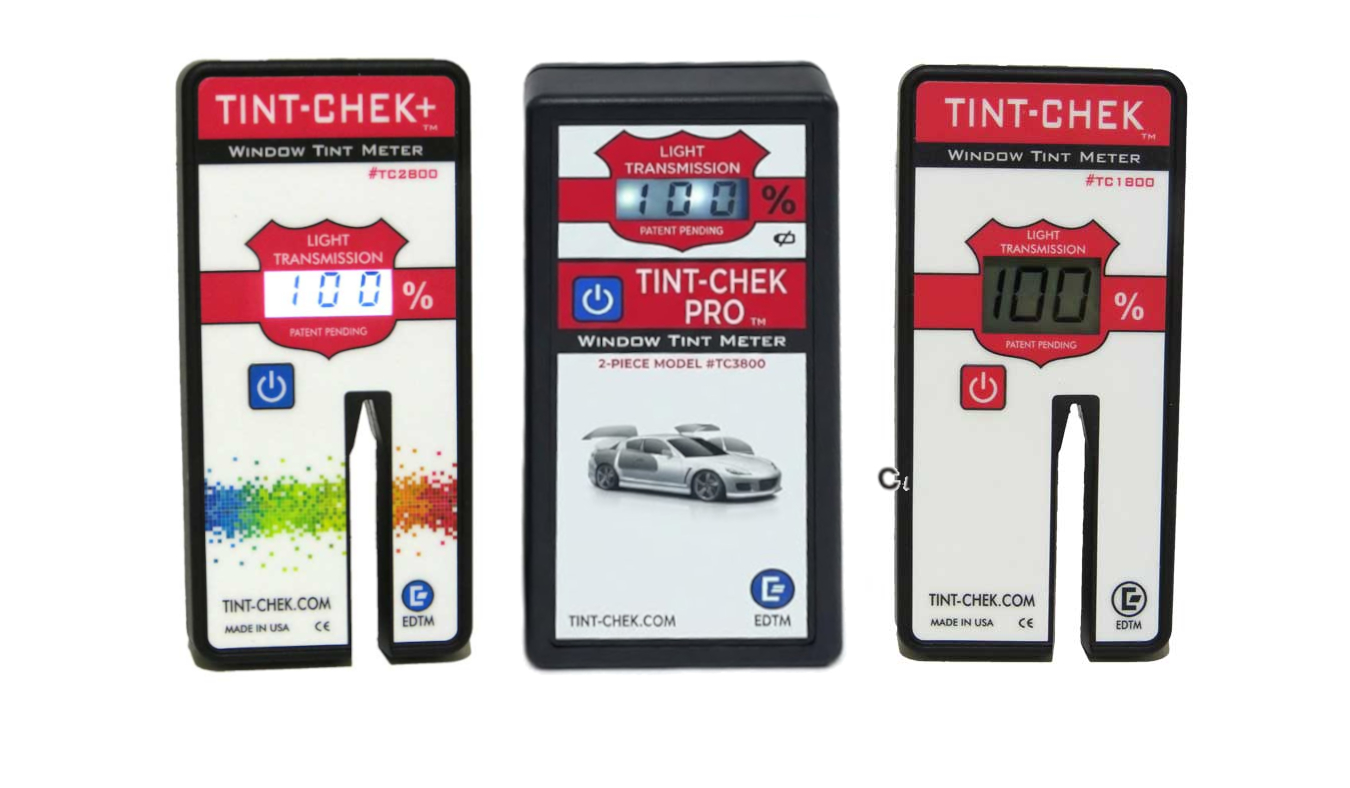
For the one-piece TC1800 and TC2800, the manufacturer’s quick-start process is simple:
1. Roll the window down at least 3 inches.
2. Clean the glass. Fingerprints, dirt, and defects affect readings.
3. Turn the meter on and wait until the display reads 100%, which means the meter is ready.
4. Slide the meter over the edge of the glass until it is fully seated against the stop, keeping the glass perpendicular to the sensor. Do not tilt it.
5. Read the display, then re-test the window to confirm the first reading.
Two details matter in the field. First, slide the meter fully onto the glass, because testing at the extreme edge can affect accuracy, especially if the film does not cover the entire window. Second, re-test every time. A repeat reading that matches the first is the simplest way to show the measurement was stable.
For windshields and rear windows, the two-piece TC3800 is designed to test windshield, rear window, and side window tint. Its quick-start process places the reflector unit on the inside of the window and the instrument unit on the exterior, then a press of the power switch shows the VLT result.
Know What Your Meter’s Numbers Mean
• Accuracy: plus or minus 2 percentage points on Tint-Chek models.
• Repeatability: 1 percentage point.
• Resolution: 1% on the TC1800 and 0.1% on the TC2800 and TC3800.
Higher resolution removes rounding. For example, a window at 39.5% VLT could be rounded to 40% on a meter that only displays whole numbers. Understand how your department and your courts treat measurement tolerance, and ask your prosecutor if you are unsure.
What to Document for Every Tint Citation
|
Item |
Why it matters |
|
Statute and window tested |
Shows which legal limit applied |
|
Meter model and identifier |
Ties the reading to a specific instrument |
|
Date and time of your calibration check |
Shows the meter was verified before use |
|
Reading and the confirming re-test |
Shows the result was repeatable |
|
Location on the glass where you measured |
Answers questions about film edges and coverage |
|
Window position during the test |
Shows how the test was conducted |
|
Photos or video per department policy |
Supports the written record |
|
Any exemption presented |
Shows it was reviewed and noted |
Factory Glass and Added Film
A tint meter measures the light passing through everything between its sensor and light source: the glass plus any film. States differ on how they treat factory tint and aftermarket film, and on whether the limit applies to the film alone or to the combined glass and film. Read the statute language for the window you are measuring, and ask your prosecutor how your jurisdiction handles it.
A Fill-In Template for Your Report
Adapt this structure to your agency’s report format. The goal is to answer every question a reviewer is likely to ask.
• Statute and window tested: [section number], [front side / rear side / rear / windshield]
• Meter: Tint-Chek [model], identifier [number]
• Pre-use verification: standards measured at [time], readings [x% and y%], within plus or minus 2% of indicated values
• Test conditions: glass cleaned [yes/no], window lowered [amount], meter fully seated against the stop
• Readings: first [x%], re-test [y%]
• Result compared with the legal limit: [meets / does not meet]
• Exemption presented: [yes/no; type of document]
• Photos or video: [per department policy]
Preparing for Court
Expect a defense attorney or reviewer to ask how you know the reading was right. Be ready to explain, in plain language:
• How you verified the meter before the stop, and where the record of that check is kept
• That the meter is calibrated at the factory to a NIST traceable standard and ships with two NIST traceable calibration standards
• Which window you measured and where on the glass
• That you repeated the measurement and the readings agreed
• The meter’s published accuracy (plus or minus 2 percentage points) and repeatability (1 percentage point), and how your agency treats tolerance
Practicing this explanation with a supervisor or prosecutor before you need it makes testimony clearer and calmer.
Common Mistakes That Weaken a Citation
• Skipping the calibration check or not recording it
• Measuring dirty glass
• Testing at the very edge of the glass
• Tilting the meter or the glass
• Recording only one reading
• Leaving out which window was measured
Frequently Asked Questions
How do officers check window tint?
Officers use a tint meter to measure visible light transmission (VLT) through the glass and film, then compare the result to the state limit for that window.
How do I know my tint meter is accurate?
Measure the supplied 27% and 59% calibration standards and confirm the readings fall within plus or minus 2% of the printed values.
Should I take more than one reading?
Yes. The manufacturer’s quick-start instructions call for re-testing the window to confirm the first result.
What is window tint enforcement based on?
State law. Limits and rules vary, so verify the current statute for your jurisdiction.
Make Every Reading Defensible
Strong window tint enforcement is a process: verify the meter, test carefully, repeat the reading, and document everything. Explore the full Tint-Chek lineup of meters built for law enforcement, all made in the USA.