

Blog
Window Tint Meter for Law Enforcement | EDTM Tint-Chek PRO
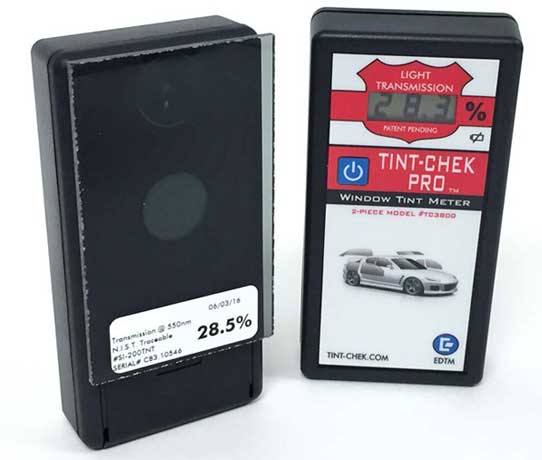
Window Tint Meter for Law Enforcement: Why Agencies Trust the EDTM Tint-Chek PRO
Officers conducting a traffic stop for suspected illegal window tint need a fast, defensible way to prove a violation on the spot. The EDTM Tint-Chek PRO is a two-piece window tint meter designed for law enforcement, police, and tint professionals. It measures Visible Light Transmission (VLT) through automotive glass and film, providing a precise digital reading that can help document tint measurements during inspections.
This guide breaks down what a tint meter does, why measurement accuracy matters so much for enforcement, and what sets the Tint-Chek PRO apart from other meters on the market.
What Is a Window Tint Meter, and Why Do Police Use One?
A window tint meter measures how much visible light passes through a vehicle's glass — expressed as a VLT percentage. Every state sets a minimum VLT threshold for windshields, front side windows, rear side windows, and back windows. Tint that falls below the legal threshold blocks too much light, which can obstruct an officer's view into the vehicle and reduce a driver's visibility at night.
Without a meter, tint darkness is a judgment call — and judgment calls don't hold up well in court. A calibrated reading does. That's the core reason window tint meters for law enforcement have become standard-issue equipment rather than optional gear: they turn a visual guess into a documented, defensible measurement.
Why Tint Enforcement Is Harder Than It Looks (State Laws Vary Widely)
Tint law isn't uniform. Front-window VLT minimums range from as low as 20% in New Mexico to 70% in states like California, Iowa, and New York — and several states apply different thresholds to front windows, rear windows, and back glass separately. Some states allow "any" darkness on rear windows but restrict the front. A few, like Michigan, regulate tint by strip width rather than percentage.
That patchwork means an officer working near a state line, or an inspection station serving customers who moved from another state, needs a meter that gives a precise, repeatable number — not an approximation. A reading of "39.5% vs. 40%" can be the difference between a citation holding up and getting dismissed, which is exactly why resolution and calibration matter as much as portability.
Introducing the EDTM Tint-Chek PRO (TC3800)
The Tint-Chek PRO (model TC3800) is EDTM's flagship two-piece tint meter, purpose-built for law enforcement, tint shops, and vehicle inspectors. Unlike single-piece meters that can only test side windows, the two-piece design — a separate reflector unit and instrument unit — allows it to measure windshields, rear windows, and side windows alike, which matters when a violation involves rear or back glass rather than just the front doors.
It's made in the USA, compact enough for one-handed operation on a roadside stop (5.1" x 2.6" x 2.0"), and ships ready to use with a protective case, two NIST-traceable calibration standards, and a 9-volt battery already installed.
Features Built for Law Enforcement Fieldwork
A few design choices specifically address the conditions officers actually work in:
- Backlit LCD display — readable at night, during traffic stops on unlit roads, or in overcast conditions, where non-backlit meters become difficult to read.
- Ambient-light correction — patent-pending processing filters out interference from stray headlights, streetlights, and cloud cover, so readings stay accurate outside a controlled environment.
- 0.1% resolution — captures fine differences (e.g., 39.5% vs. 40%) that lower-resolution meters round away, which matters when a stop is close to the legal threshold.
- Tool-free battery access — a slide-out cover means no screws to lose and no risk of knocking the unit out of calibration during a battery swap in the field.
- Auto shutoff — conserves battery life for meters that may sit in a vehicle for weeks between call-outs.
How It Works: A 3-Step Measurement Process
Part of why the Tint-Chek PRO is practical for a roadside stop is its speed:
- Power on — press the power button.
- Position — place the two-piece unit on the window, aligned by built-in magnets.
- Read — press the button again; the digital, microprocessor-controlled result locks in without drifting.
No warm-up period, no manual calculation — just a stable percentage reading within seconds.
Accuracy You Can Defend in Court
Enforcement equipment is only useful if the numbers hold up under scrutiny. The Tint-Chek PRO ships factory-calibrated to a NIST-traceable standard (the U.S. government's official measurement standards body), with two calibration references included in the box so agencies can verify accuracy over the unit's lifetime. Combined with 0.1% resolution and ambient-light correction, that gives departments a reading that's not just fast, but defensible when a citation is challenged.
Tint-Chek PRO vs. Other Tint Meters on the Market
Compared to single-piece meters (including EDTM's own TC1800 and TC2800), the Tint-Chek PRO's two-piece design is the main differentiator — it's the only one in the lineup that tests windshields and rear glass in addition to side windows. It also shares the backlit display and 0.1% resolution found on the TC2800, but adds the broader glass coverage the single-piece models can't match. For departments that only need side-window checks, the lighter TC1800 or TC2800 may be sufficient; for full-vehicle inspection capability, the TC3800 is the more complete tool.
Who Relies on the Tint-Chek PRO
- Law enforcement agencies — roadside compliance checks and citation support
- Window tint installers — verifying film meets legal VLT before a customer leaves the shop
- Vehicle inspection stations — state safety and emissions inspections that include tint checks
- Fleet and dealership compliance teams — pre-sale or pre-lease tint verification
Frequently Asked Questions
What does a window tint meter measure?
It measures Visible Light Transmission (VLT) — the percentage of visible light that passes through a vehicle's window glass and film combined.
Is the EDTM Tint-Chek PRO approved for law enforcement use?
Yes. It's part of EDTM's Tint-Chek line, which is built and marketed specifically for law enforcement and tint-compliance inspection use, with NIST-traceable calibration for documented, defensible readings.
Can the Tint-Chek PRO test windshields, not just side windows?
Yes — its two-piece design is built specifically to test windshields and rear windows in addition to side windows, unlike single-piece meters limited to side glass.
How accurate is the Tint-Chek PRO?
It reads to the nearest 0.1% VLT and is factory-calibrated to a NIST-traceable standard, with two calibration references included for ongoing verification.
How long does the battery last?
It runs on a single 9-volt alkaline battery with an auto-shutoff feature that conserves power between uses.
Get the Tint-Chek PRO for Your Department
Departments and inspection stations replacing outdated meters — or outfitting new units — can find full specs and pricing on the EDTM Tint-Chek PRO product page. For more on EDTM's full line of inspection instruments, visit EDTM.