

Blog
Window Tint Enforcement for Law Enforcement: VLT Limits, Testing & Documentation Best Practices
Window tint enforcement is the process of measuring a vehicle's window tint with a tint meter and comparing the reading to the legal limit for that window. Officers measure visible light transmission (VLT), the percentage of visible light passing through the glass and any film, and record the result.
What is window tint enforcement?
Enforcement starts with a number, not a judgment by eye. An officer places a tint meter on the window, reads the VLT percentage, and compares it to the limit for that window and vehicle. This guide covers the limits, how tint is tested, and what published agency policies say about documenting the test.
Key terms
|
Term |
Definition |
|
VLT |
Visible light transmission, also called transmittance. The percentage of visible light that passes through glass and any film on it. |
|
VLT limit |
The minimum VLT a window must allow under the law that applies to it. A higher VLT means a lighter window. |
|
Calibration check |
A test of the meter against a known reference sample, such as the calibration standards that come with the meter. |
|
NIST traceable calibration |
Calibration linked to a standard from the National Institute of Standards and Technology, a government standards agency. |
|
Two-piece meter |
A meter made of an instrument unit, which holds the electronics, and a reflector unit, which holds the reflector and magnets that align the two pieces. |
What are the VLT limits for vehicle windows?
|
Jurisdiction |
Requirement |
Source |
|
U.S. federal, new vehicles |
FMVSS No. 205 requires at least 70% light transmittance in glazing areas requisite for driving visibility. In passenger cars this includes all windows. In trucks, buses, and multipurpose passenger vehicles, it covers the windshield, the front side windows, and any rear window used for driving visibility. |
NHTSA interpretation letters |
|
U.S. windshields |
An area of a windshield below 70% must be marked with the AS-1 line. |
NHTSA interpretation letters |
|
U.S. commercial motor vehicles |
Tinting of windshields and the windows immediately right and left of the driver is allowed only if parallel luminous transmittance is at least 70% in the marked portions. The restriction does not apply to other windows on the commercial motor vehicle. |
49 CFR 393.60(d) |
|
U.S. states |
Each state sets its own rules for vehicles in use. NHTSA has said states are free to set levels for windows that FMVSS No. 205 does not cover. |
NHTSA; state law |
FMVSS No. 205 applies to the manufacture and sale of new vehicles and equipment. Because limits for vehicles in use are set by each state, the number an officer compares a reading to depends on the state and the window being tested.
Limits for vehicles in use differ by state and by window position. Always confirm the current limit in the statute that applies before you test.
How do officers test window tint?
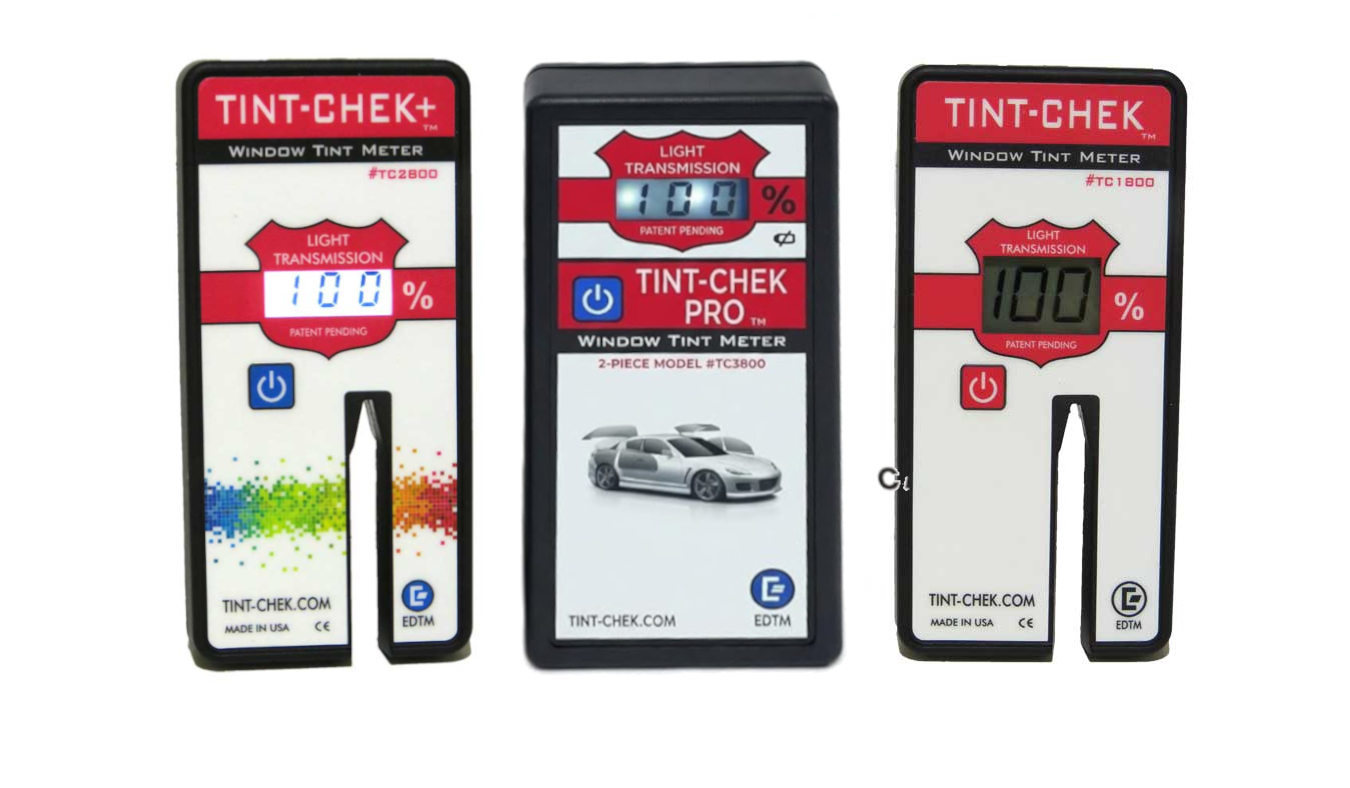
Officers place a tint meter on the window and read the VLT percentage on the display. Tint-Chek meters measure the VLT of automotive glass and any glass and film combination up to 1/4 inch (6.5 mm) thick.
|
Meter type |
How it works |
Tint-Chek model |
|
One-piece meter |
The glass slides into an opening in the meter. |
TC1800 and TC2800 |
|
Two-piece meter |
An instrument unit and a reflector unit sit on either side of the glass, aligned by magnets. It tests windshield, rear window, and side window tint. |
TC3800 PRO |
The TC3800 works in three steps: push the power button, place the meter on the window, and press the power button to get the result. The meter locks on one result, so the value does not drift on the display.
Roadside conditions can interfere with a reading. Stray headlights and cloud cover have been known to affect older VLT meters, so Tint-Chek meters use patent-pending techniques to remove changing ambient light. The TC2800 and TC3800 also have a backlit LCD display for evening and overcast conditions.
Each Tint-Chek meter turns itself off after several minutes of non-use to conserve battery power. The TC3800 is sized for single-hand operation.
The TC1800 and TC2800 have no lever switches or moving parts, so the glass can be slid in from any direction without risk of damaging a switch or scratching the glass.
What do agency policies say about documenting a tint test?
Documentation requirements come from each department's policy. The examples below come from published agency policies and are not universal rules. Follow your own department's policy.
|
Practice |
Example from a published policy |
Source |
|
Training before use |
Officers complete training in the use of a tint meter before operating it. |
Cleveland Division of Police |
|
Calibration test before use |
A calibration test is completed before the meter is used. Florida Highway Patrol requires the test each day the meter is used. |
Cleveland Division of Police; Florida Highway Patrol |
|
Own reference sample |
Each tint meter has its own reference sample to verify the meter. |
Florida Highway Patrol |
|
Clean the test area |
Officers make sure the area of the window to be tested is clean. |
Florida Highway Patrol |
|
Record the reading |
The meter display reading is documented in the officer notes or comments section of the citation for later use in court. |
Florida Highway Patrol |
|
Keep a test log |
The meter serial number and any calibration tests are documented in a tint meter test log. |
Florida Highway Patrol |
|
Note calibration on the summons |
The last factory calibration date, and the fact that calibration was manually verified, is noted on the affidavit portion of the summons. |
Colorado Springs Police Department |
|
Remove failed meters |
Units that fail calibration tests are removed from service until corrected. |
Colorado Springs Police Department |
Training matters beyond the field. A state traffic safety course for police officers lists calibration and certification requirements, operating procedures, and courtroom preparation among its topics, and notes that defense attorneys have challenged officers' training in the use of the meter in some cases.
Which Tint-Chek model fits which enforcement task?
|
Task |
Model |
Why |
|
Test the windshield and rear window |
TC3800 PRO |
The two-piece design allows testing of windshield, rear window, and side window tint. |
|
Test in the evening, on overcast days, or indoors |
TC2800 or TC3800 |
Both have a backlit LCD display. |
|
Carry the meter in a pocket |
TC1800 or TC2800 |
Both are 5 x 2.5 x 1 in, and thin enough to fit in a shirt pocket. |
|
Test a window that does not open far |
TC1800 or TC2800 |
Both are easier to slip around the tight edges of a car window that does not open as far. |
|
Operate with one hand |
TC3800 PRO |
At 5.1 x 2.6 x 2.0 in, it is sized for single-hand operation. |
Every model measures glass and any glass and film combination up to 1/4 inch (6.5 mm) thick, comes factory calibrated to a NIST traceable standard, and includes a protective carrying case, two NIST traceable calibration standards, and a 9-volt battery.
The TC1800 is the compact tint gauge in the line. It is thin enough to fit in a shirt pocket, and it can slip around the tight edges of a car window that does not open far.
The TC2800 is a tint tester that adds a backlit display and a finer 0.1% display resolution to the TC1800's design. It is designed for law enforcement, police, and tinters.
The TC3800 PRO is a two-piece window tint meter for windshield, rear window, and side window testing. It is also designed for law enforcement, police, and tinters.
Frequently asked questions
What does VLT mean?
VLT stands for visible light transmission, also called transmittance. It is the percentage of visible light that passes through the glass and any film on it. A reading of 0% means no light passes through, and 100% means all light passes through.
What is the federal VLT limit for vehicle windows?
FMVSS No. 205 requires at least 70% light transmittance in glazing areas requisite for driving visibility on new vehicles. In passenger cars this includes all windows. Limits for vehicles already on the road are set by each state.
Do tint limits differ by state?
Yes. NHTSA has said states are free to set levels for windows that FMVSS No. 205 does not cover. Always check the statute that applies where you work.
Does a tint meter read the glass and the film together?
Tint-Chek meters measure the VLT of automotive glass and any glass and film combination up to 1/4 inch (6.5 mm) thick.
Should officers check the meter before testing?
Several published agency policies require a calibration test before use. Florida Highway Patrol requires a test each day the meter is used, and Cleveland Division of Police requires a calibration test before use. Follow your own department's policy.
What should be documented after a tint test?
Published agency policies give examples: the meter display reading in the citation notes, the meter serial number and calibration tests in a test log, and the last factory calibration date on the summons. Your department's policy sets the requirement.
Do officers need training to use a tint meter?
Some agency policies require it. Cleveland Division of Police requires officers to complete training before operating a tint meter.
Can a tint meter be used at night?
Yes, with a backlit display. The TC2800 and TC3800 have a backlit LCD, which helps in the evening, on overcast days, and indoors.
How thick a window can a Tint-Chek measure?
Tint-Chek meters measure glass and any glass and film combination up to 1/4 inch (6.5 mm) thick.
What comes with a Tint-Chek meter?
Each model includes a protective carrying case, two NIST traceable calibration standards, and a 9-volt battery, so it is ready to use out of the box.
Sources
• NHTSA interpretation: FMVSS No. 205 light transmissibility by vehicle type
• NHTSA interpretation: AS-1 line and windshield shade bands
• NHTSA interpretation: FMVSS No. 205 and ANSI Z26.1 scope
• 49 CFR 393.60: glazing in specified openings
• Florida Highway Patrol policy: Use of Tint Meters
• Cleveland Division of Police policy: Window Tint Meters
• Colorado Springs Police Department SOP: Window Tint Meters
• Tennessee Highway Safety Office: Motor Vehicle Window Tint Meter Train-the-Trainer