

Blog
Handheld Tint Tester for Patrol Use: Durability, Reliability, and Field Accuracy
A handheld tint tester for patrol use has to hold up to daily handling, give a steady reading, and be quick to use in the field. This guide looks at what makes a tint tester durable, what makes its electronics reliable, and which Tint-Chek features support consistent readings.
What does a handheld tint tester measure?
A tint tester measures visible light transmission (VLT), the percentage of visible light that passes through a window and any film on it. Tint-Chek meters measure the VLT of automotive glass and any glass and film combination up to 1/4 inch (6.5 mm) thick. They are designed for law enforcement, police, and tinters.
What should you look for in a handheld tint tester for patrol use?
Before you compare models, it helps to ask a few questions:
• Does it avoid parts that can wear out or break?
• Can it cope with changing light from headlights or cloud cover?
• Is its calibration traceable, and are calibration standards included?
• Can you read the display in the evening or indoors?
• Is it small enough to carry, and can you use it with one hand?
• Can you change the battery without opening the unit?
The sections below show how the Tint-Chek line answers each question.
What makes a handheld tint tester durable?
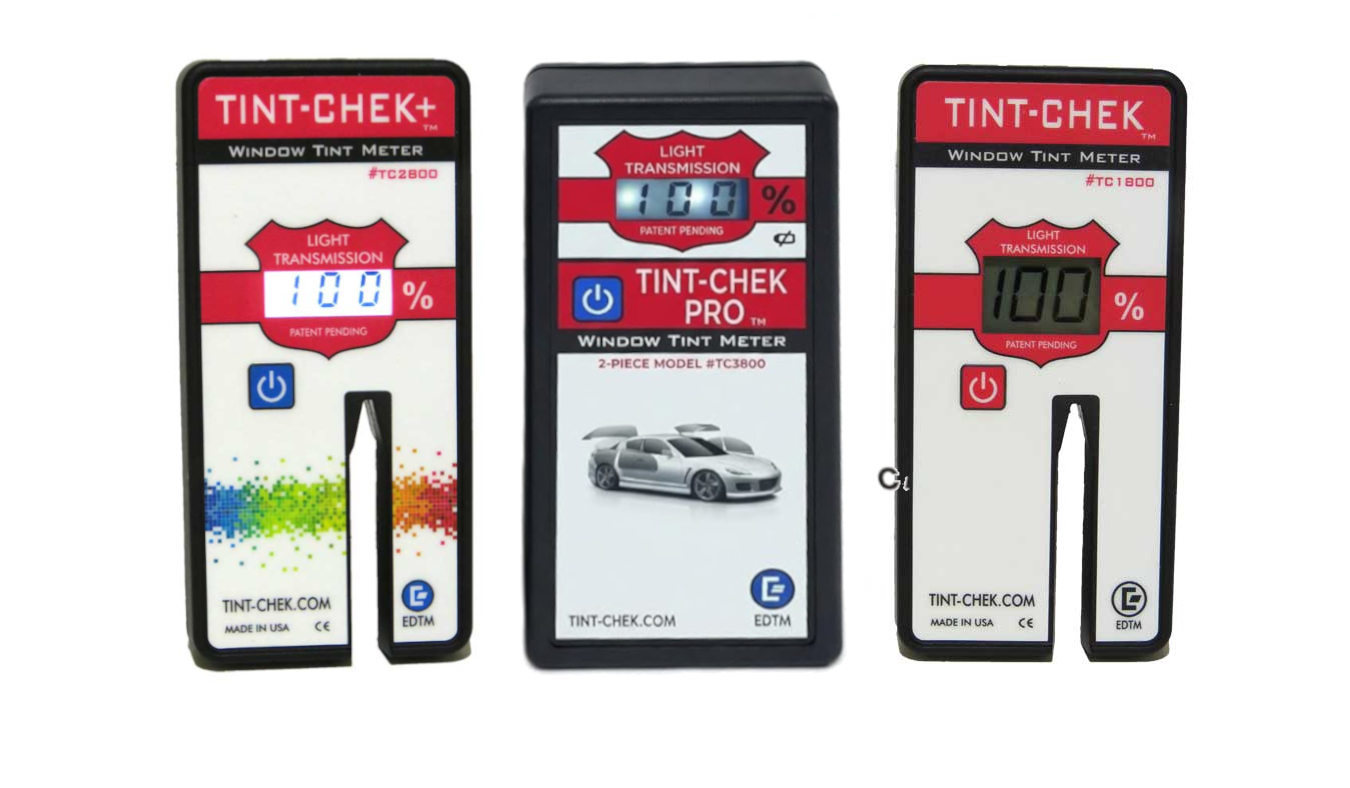
• No moving parts. The TC1800 and TC2800 have no mechanical lever switches. Some tint meters use a lever that trips when it is pressed against the glass. With these models, the glass slides into the opening from any direction, so there is no switch to damage and no risk of scratching the glass.
• Rugged build. The TC1800, TC2800, and TC3800 are each described as rugged and made with quality components that will last years.
• Protective carrying case. Every model comes with one.
• Compact size. The TC1800 and TC2800 measure 5 x 2.5 x 1 inches, thin enough to fit in a shirt pocket. They can also slip around the tight edges of a car window that does not open far.
• Electronics kept apart. In the two-piece TC3800, the instrument unit holds all of the electronics. The reflector unit has no electronics and holds the reflector and the magnets that align the two pieces.
The TC1800 is the compact tint gauge in the line, and the lever-free design carries across the TC2800.
What makes a handheld tint tester reliable?
• All-digital electronics. As a digital tint meter, the Tint-Chek uses microprocessor-controlled electronics that take high-speed measurements shown on a real-time display.
• Locked results. The meter locks on one result, so the value does not drift.
• Automatic shut-off. The meter turns itself off after several minutes of non-use to conserve battery power.
• Battery included. Each model ships with a 9-volt battery, so it is ready to take measurements out of the box.
The TC3800 Tint-Chek PRO adds a slide-out battery cover that sits away from the electronics. You can change the battery without opening the unit, so there is no risk of damaging the unit or its calibration. It is sized for single-hand operation, and the process takes three steps: push the power button, place the meter on the window, and press the power button again to get the result.
What supports field accuracy in a handheld tint tester?
• Ambient light handling. Stray headlights and cloud cover have been known to affect older VLT meters. Tint-Chek meters use patent-pending techniques to remove ambient light conditions that can change in the testing environment.
• NIST traceable calibration. The meters come from the factory calibrated to a NIST traceable standard, and each model includes two NIST traceable calibration standards.
• Backlit display. The TC2800 and TC3800 have a backlit LCD, which helps in the evening, on overcast days, and indoors.
• Finer display resolution. The TC2800 and TC3800 show the reading to the nearest 0.1%, so a window at 39.5% VLT shows as 39.5% instead of 40%.
• Glass and film together. The meter measures the glass and any film combined, up to 1/4 inch (6.5 mm) thick.
How do agencies keep a tint tester dependable in the field?
Many agencies add their own checks. These examples come from published agency policies and are not universal rules. Follow your own department's policy.
• Florida Highway Patrol requires each meter to have its own reference sample and a test for accuracy each day the meter is used. The meter serial number and tests go in a test log.
• Colorado Springs Police Department notes the last factory calibration date and the manual verification of calibration on the summons, and it removes units that fail calibration tests from service.
• Cleveland Division of Police requires officers to complete training and a calibration test before using a tint meter.
Which Tint-Chek features matter most for patrol use?
|
Feature |
Why it matters |
Models |
|
No lever switch or moving parts |
Nothing to break, and no risk of scratching the glass. |
TC1800, TC2800 |
|
Locked result |
The value does not drift on the display. |
All models |
|
Ambient light handling |
Stray headlights and cloud cover are removed from the reading. |
All models |
|
Backlit display |
Readings are easy to see in the evening, on overcast days, and indoors. |
TC2800, TC3800 |
|
Automatic shut-off |
Conserves battery power. |
All models |
|
Slide-out battery cover |
Change the battery without opening the unit. |
TC3800 |
|
Pocket-size body |
5 x 2.5 x 1 in, thin enough for a shirt pocket. |
TC1800, TC2800 |
|
Single-hand operation |
Sized for one hand, with a three-step process. |
TC3800 |
|
Included in the box |
Carrying case, two NIST traceable calibration standards, and a 9-volt battery. |
All models |
Frequently asked questions
What is a handheld tint tester?
A handheld tint tester is a portable meter that measures visible light transmission (VLT), the percentage of visible light that passes through a window and any film on it. It is also called a tint gauge or a digital tint meter. Tint-Chek meters are designed for law enforcement, police, and tinters.
Does a Tint-Chek have moving parts?
The TC1800 and TC2800 are designed with no moving parts and no mechanical lever switches, which supports reliability and durability.
Is a Tint-Chek built to last?
The TC1800, TC2800, and TC3800 are each described as rugged and made with quality components that will last years.
Can a tint tester be used at night?
Yes, with a backlit display. The TC2800 and TC3800 have a backlit LCD, which helps in the evening, on overcast days, and indoors.
Do stray headlights affect a tint tester reading?
Changing ambient light has been known to affect older VLT meters. Tint-Chek meters use patent-pending techniques to remove ambient light conditions that change in the testing environment.
How thick a window can a Tint-Chek measure?
Tint-Chek meters measure glass and any glass and film combination up to 1/4 inch (6.5 mm) thick.
How do you change the battery in a Tint-Chek?
The TC3800 has a slide-out battery cover away from the electronics, so you do not have to open the unit to change the 9-volt alkaline battery.
Can you use a tint tester with one hand?
The TC3800 is sized for single-hand operation at 5.1 x 2.6 x 2.0 inches, and it takes three steps: push the power button, place it on the window, and press the power button again.
Does a tint tester fit in a pocket?
The TC1800 and TC2800 measure 5 x 2.5 x 1 inches and are thin enough to fit in a shirt pocket.
What comes with a Tint-Chek meter?
Each model includes a protective carrying case, two NIST traceable calibration standards, and a 9-volt battery, so it is ready to use out of the box.
Choose a tint tester built for patrol work
Compare the TC1800, TC2800, and TC3800 in our digital tint meter range to find the Tint-Chek that fits your department.
Not sure which model to pick? Read our guide to the best tint meter for police officers.