

Blog
How to Equip Your Police Department With Tint Meters: Budget, Training, and Buying Guide
A tint meter turns a roadside judgment call into a measurement. For a police agency, that means an officer can read the visible light transmission (VLT) of a window instead of relying on a guess. Equipping your department well takes three decisions: which meters to buy, how much to budget, and how to train your people to use them.
This guide walks through all three. It compares the three Tint-Chek models, shows the volume pricing listed for the TC3800, and gives a simple plan for training officers. Every product detail comes from the Tint-Chek product pages.
The Short Answer
• For most patrol officers, a one-piece meter such as the TC2800 is the practical choice. It displays to the nearest 0.1% and has a backlit display for testing at night.
• For windshield and rear window testing, add the two-piece TC3800 car tint meter. It is the model designed for those windows.
• For a compact, simple meter for side window testing, look at the TC1800 digital tint meter.
• For budgeting, multiply the number of meters by the unit price, then add officer training time. The TC3800 lists lower prices at 5 and 10 meters.
What Is VLT, and What Does a Tint Meter Measure?
VLT stands for Visible Light Transmission, also called transmittance. It is the share of visible light that passes through a window and any film on it. A tint meter measures that number for automotive glass, and for any glass or film up to 1/4 inch (6.5 mm) thick.
Tint laws set limits on VLT, and those limits differ by state and jurisdiction. This guide does not cover specific limits, so always follow your own state law and agency policy.
Step 1: Decide Where Your Department Will Use Tint Meters
Start with the work, not the model. Ask which units and teams will test windows:
1. List every unit that checks window tint, such as patrol, traffic enforcement, and vehicle inspection.
2. Note which windows they test most often: side windows, rear windows, or windshields.
3. Decide whether officers work mostly in daylight or also at night and indoors.
4. Decide how many meters each unit needs. Some agencies assign one to each vehicle, while others keep a shared pool.
Your answers point to the right model in the next step.
Step 2: Choose the Right Tint-Chek Model
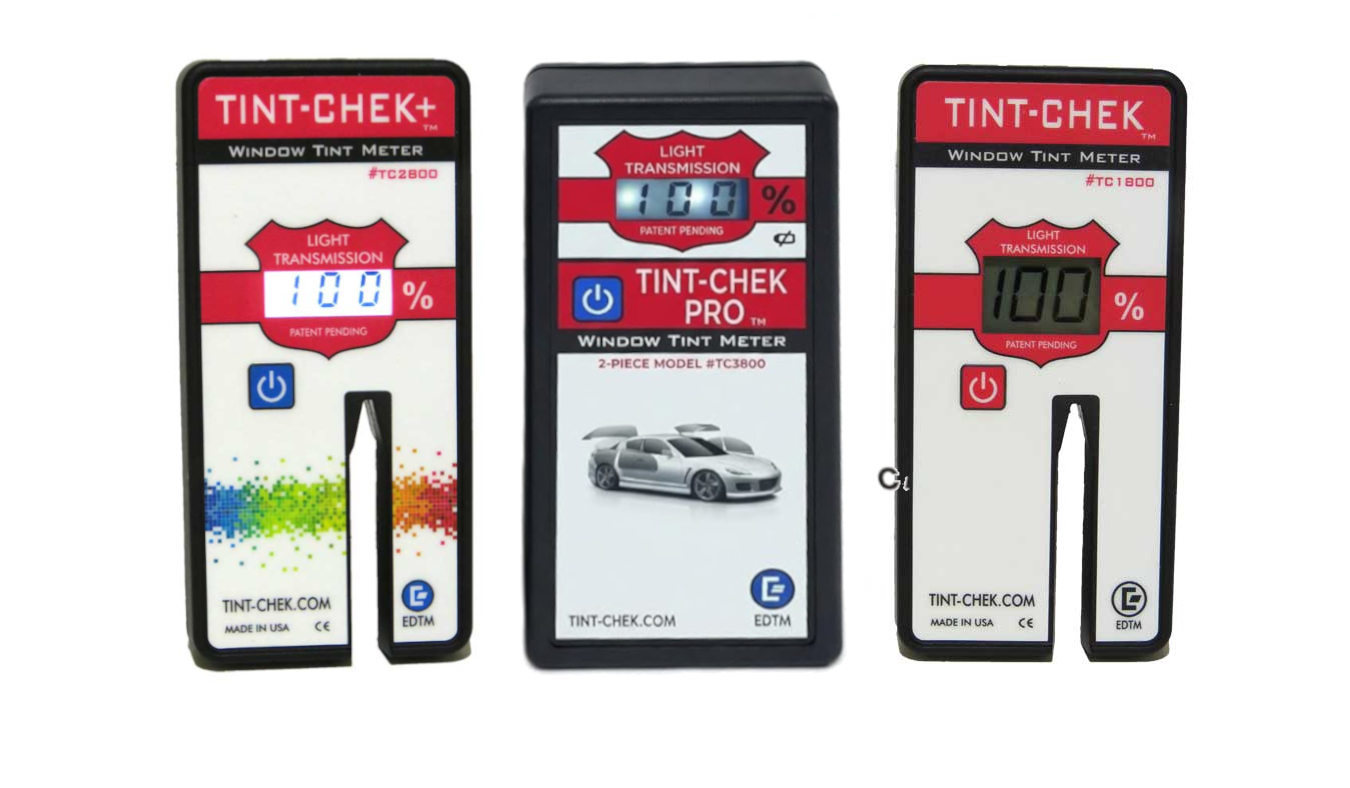
All three Tint-Chek meters measure VLT, come factory calibrated to a NIST traceable standard, and are made in the USA. Here is how they compare.
|
Feature |
TC1800 |
TC2800 |
TC3800 PRO |
|
Design and size |
|||
|
Design |
Single unit |
Single unit |
Two-piece |
|
Size |
5" x 2.5" x 1" |
5" x 2.5" x 1" |
5.1" x 2.6" x 2.0" |
|
Two-piece design for windshield and rear window testing |
No |
No |
Yes |
|
Measurement |
|||
|
Measures VLT of glass and film up to 1/4" (6.5 mm) |
Yes |
Yes |
Yes |
|
Displays to the nearest 0.1% |
No |
Yes |
Yes |
|
Backlit LCD display |
No |
Yes |
Yes |
|
Factory calibrated to a NIST traceable standard |
Yes |
Yes |
Yes |
|
Patent-pending ambient light technique |
Yes |
Yes |
Yes |
|
Locks on one result (no drifting values) |
Yes |
Yes |
Yes |
|
Turns itself off after several minutes |
Yes |
Yes |
Yes |
|
Included and built |
|||
|
Protective carrying case |
Yes |
Yes |
Yes |
|
Two NIST traceable calibration standards |
Yes |
Yes |
Yes |
|
9-volt battery included |
Yes |
Yes |
Yes |
|
Made in the USA |
Yes |
Yes |
Yes |
|
Designed for law enforcement, police, and tinters |
Yes |
Yes |
Yes |
TC1800 Tint-Chek: the compact, simple model
The TC1800 digital tint meter is all-digital and microprocessor controlled. It takes high-speed measurements and locks on one result, so values do not drift. It has no mechanical lever switch, so you can slide the glass into the opening in any direction without worrying about damaging a lever or scratching the glass.
At 5" x 2.5" x 1", it fits in a shirt pocket and slips around the tight edges of a car window that does not open very far. Its display is 35% larger than competing models, which makes it easier to read.
TC2800 Tint-Chek +: backlight and finer resolution
The TC2800 tint meter keeps the compact size and the no-lever design of the TC1800 and adds two upgrades. The first is a backlit LCD display, which helps in the evening, on overcast days, and indoors. Tint-Chek states that the TC2800 and TC3800 are the only products on the market with a backlit display.
The second is increased resolution. The TC2800 displays to the nearest 0.1%, which removes rounding errors. For example, a window at 39.5% VLT could be rounded up to 40% on a meter that only shows the nearest 1%. When a reading sits close to a limit, that extra precision matters.
TC3800 Tint-Chek PRO: the two-piece meter for windshields and rear windows
The TC3800 car tint meter uses a two-piece design that is exclusive to this model. The Reflector Unit has no electronics and holds the reflector and magnets that help align the two enclosures. The Instrument Unit holds all the electronics. Together they allow testing of windshield, rear window, and side window tint.
The TC3800 also has a backlit display and reads to the nearest 0.1%. Operation takes three steps: push the power button, place the meter on the window, and press the power button again to see the result. A slide-out battery cover keeps the electronics closed during battery changes, so there are no screws to lose and no risk of disturbing the calibration. At 5.1" x 2.6" x 2.0", it is sized for one-hand use.
Which model suits which officer?
• Patrol officers who test side windows: TC2800 for the backlight and 0.1% display, or TC1800 if you do not need those features.
• Traffic units and inspection teams who test windshields and rear windows: TC3800.
• Night shifts: TC2800 or TC3800, since both have a backlit display.
• A mixed fleet: many agencies will want a few TC3800 units for windshield and rear window work and TC2800 or TC1800 meters for everyday side window checks.
Step 3: Build Your Budget
Pricing for each model is on its product page. The TC3800 lists a lower price per meter as the order grows, which matters when you equip several units at once:
|
Quantity |
Price per TC3800 |
Total for the order |
|
1 |
$229 |
$229 |
|
5 |
$219 |
$1,095 |
|
10 |
$209 |
$2,090 |
These prices were listed on the TC3800 product page when this article was written. Check the page for current pricing, and look at the TC2800 and TC1800 pages for their prices.
A simple budget has these lines:
• Meters: number of meters multiplied by the unit price for each model.
• Spare batteries: every meter ships with a 9-volt battery, so it is ready to use out of the box. Keeping spares on hand avoids downtime.
• Training time: officer hours for the training session in the next step.
• Policy and documentation: time to write or update your testing procedure.
Each meter also includes a protective carrying case and two NIST traceable calibration standards, so you do not need to budget for those separately.
Step 4: Train Your Officers
A meter is only as useful as the person using it. The meters are simple to operate, so training can be short and hands-on. Here is a plan you can adapt to your agency:
1. Explain VLT in plain language, and cover your state law and agency policy on tint limits.
2. Show the meter and its parts. On the TC3800, point out the Reflector Unit and the Instrument Unit.
3. Demonstrate a measurement. For the TC3800, that is three steps: push the power button, place the meter on the window, and press the power button again. For the TC1800 and TC2800, slide the glass into the opening.
4. Let each officer practice on several windows, including a window that does not open all the way. The slim TC1800 and TC2800 are designed to slip around tight edges.
5. Practice in low light with the backlight if you chose a TC2800 or TC3800.
6. Teach officers to read the result to the nearest 0.1% if your model supports it.
7. Agree on how readings are recorded in your reports.
Keep the two calibration standards that come with each meter with the unit, and make them part of your procedure. Ask your own legal and policy advisers how your agency should document testing.
Why Police Agencies Choose Tint-Chek Meters
• Made in the USA. The meters are built with quality components that are meant to last for years, and EDTM invites you to pick up the phone if you have questions.
• Calibrated from the factory. Each meter comes calibrated to a NIST traceable standard, the U.S. government’s standards agency reference.
• Built for real conditions. Patent-pending techniques remove changing ambient light, such as stray headlights and cloud cover, which have been known to affect the performance of older VLT meters.
• No lever switches on the TC1800 and TC2800. With no moving parts, there is no lever to break and no risk of scratching the glass.
• Designed for law enforcement, police, and tinters. All three models are built for this work.
Frequently Asked Questions
What does a tint meter measure?
It measures VLT, or Visible Light Transmission, of automotive glass and any glass or film up to 1/4 inch (6.5 mm) thick.
What is the difference between the TC1800 and the TC2800?
Both are single-unit meters with no lever switch. The TC2800 adds a backlit display and displays to the nearest 0.1%.
Which tint meter tests windshields?
The two-piece TC3800 is the model designed for windshield and rear window testing, in addition to side windows.
Can I use a tint meter at night?
Yes, with a backlit model. The TC2800 and TC3800 have a backlit display for dark environments.
What comes with each meter?
A protective carrying case, two NIST traceable calibration standards, and a 9-volt battery.
How is the meter powered?
A single 9-volt alkaline battery. The meters turn themselves off after several minutes of non-use to conserve battery power.
Are Tint-Chek meters made in the USA?
Yes. The TC3800 product page states it is manufactured in the USA by EDTM, Inc., and all three product pages state they are made in the USA.
Ready to Equip Your Department?
Start with how your officers will use the meters, match each use to a model, and plan the budget and training around it. For everyday side window checks, look at the TC2800 tint meter or the TC1800 digital tint meter. For windshield and rear window testing, look at the TC3800 car tint meter. If you have questions about equipping your department, call the Tint-Chek team.