

Blog
Best Tint Meter for Police Officers: Patrol Features
A tint stop doesn't happen in a lab. It happens on a roadside at dusk, in the rain, or under passing headlights, often with traffic going by. The right tint meter for police officers has to give a fast, readable result in those conditions, not just on a bright afternoon.
This guide walks through the features that matter most when you're choosing a tint meter for patrol, and how EDTM's Tint-Chek models compare for that kind of work.
What Does a Police Tint Meter Do?
A tint meter measures Visible Light Transmittance (VLT), the percentage of visible light that passes through a window and any film on it. A lower VLT means a darker window. Because tint laws are written as VLT percentages, a tint meter lets an officer check a window against the legal limit instead of estimating by eye.
You'll hear several names for the same tool: tint meter, digital tint meter, car tint meter, and tint tester. They all describe a handheld device that reads window tint darkness. If you're new to the terminology, our guide on the difference between a tint meter, tint gauge, and tint tester explains how the names overlap. [ADD LINK TO YOUR FIRST ARTICLE HERE]
Why a Dedicated Tint Meter Beats Guessing
Judging tint by eye is unreliable. Lighting, window angle, and vehicle color all change how dark a window looks. A digital tint meter replaces opinion with a number, which helps officers apply the rules consistently and helps drivers understand why a window was flagged.
Features That Matter on Patrol
1. Accuracy in Changing Light
Patrol means testing in all conditions. Stray headlights and cloud cover can affect older VLT meters. The Tint-Chek line uses patent-pending techniques to remove changing ambient light from the measurement, so readings stay dependable outside the shop.
2. A Backlit Display for Night Work
A lot of traffic stops happen after dark. A backlit LCD makes the reading easy to see in the evening, on overcast days, or indoors. The TC2800 and TC3800 both include a backlit display. The TC1800 does not.
3. Fine Resolution Near the Legal Limit
Some windows land right at the limit, and rounding can change the outcome. The TC2800 and TC3800 display readings to the nearest 0.1%. For example, a window at 39.5% VLT could be rounded up to 40% by a meter that only shows whole numbers. Finer resolution removes that rounding error.
4. Portable, Pocket-Friendly Size
Officers carry a lot of gear. The TC1800 and TC2800 measure just 5" x 2.5" x 1", thin enough to fit in a shirt pocket. That slim profile also helps the meter slide around the tight edges of a window that doesn't open far. The two-piece TC3800 is 5.1" x 2.6" x 2.0" and is sized for one-handed use.
5. No Mechanical Lever Switch
Some meters use a lever switch that triggers when pushed against the glass. That's a moving part that can wear out, and it can scratch the window being tested. Tint-Chek meters have no moving parts for this purpose. You slide the glass into the opening in any direction without worrying about damaging a switch or the glass.
6. Simple, Fast Operation
On the road, fewer steps means less time at the window. The TC3800 works in three steps: press the power button, place the meter on the window, and press the power button again to get the result. All Tint-Chek meters use digital, microprocessor-controlled electronics that take high-speed measurements, lock on one result, and don't drift.
7. Calibration You Can Verify
A reading is only as good as the meter's calibration. Every Tint-Chek meter is factory calibrated to a NIST-traceable standard and ships with two NIST-traceable calibration standards, so you can check the meter's performance. Follow your department's policy for how often to verify.
8. Durable, Easy-to-Maintain Build
Tint-Chek meters are made in the USA with quality components designed to last for years. They run on a single 9-volt battery and shut off automatically after several minutes of non-use to save power. On the TC3800, a slide-out battery cover means you can change the battery without opening the unit, so there's no risk of disturbing the electronics or calibration.
9. Ability to Test Every Window
Side windows are the most common check, but windshields and rear windows matter too. One-piece meters are designed for glass that slides into the opening. For windshields and rear windows, you need a two-piece design.
Comparing the Tint-Chek Models for Police Use
All three models measure automotive glass and any glass or film up to 1/4" (6.5 mm) thick, and each comes with a protective carrying case, two NIST-traceable calibration standards, and a 9-volt battery.
|
Feature |
TC1800 |
TC2800 |
TC3800 |
|
Design |
One-piece |
One-piece |
Two-piece |
|
Tests side windows |
Yes |
Yes |
Yes |
|
Tests windshield and rear window |
No |
No |
Yes |
|
Backlit LCD display |
No |
Yes |
Yes |
|
0.1% resolution |
No |
Yes |
Yes |
|
Ambient light removal |
Yes |
Yes |
Yes |
|
NIST-traceable calibration |
Yes |
Yes |
Yes |
|
No mechanical lever switch |
Yes |
Yes |
Yes |
|
Size |
5" x 2.5" x 1" |
5" x 2.5" x 1" |
5.1" x 2.6" x 2.0" |
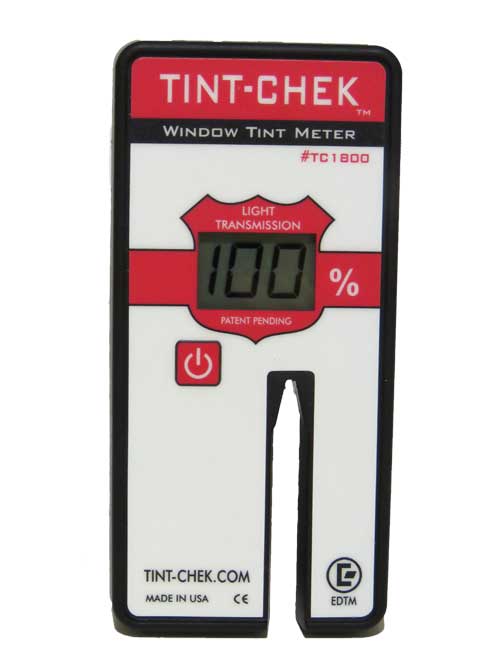
TC1800 Tint-Chek Window Tint Meter
The TC1800 is a compact, one-piece car tint meter with a display 35% larger than competing models. It's a solid choice for side-window checks when you don't need a backlight.
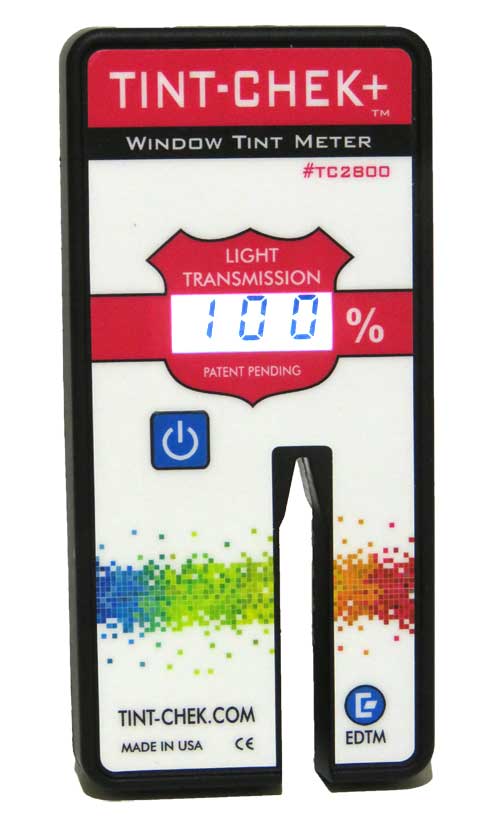
TC2800 Tint-Chek + Window Tint Meter
The TC2800 is a digital tint meter that adds a backlit LCD and 0.1% resolution to the TC1800's feature set. For officers who work nights or want the finest reading on side windows, this is the one-piece model to look at.
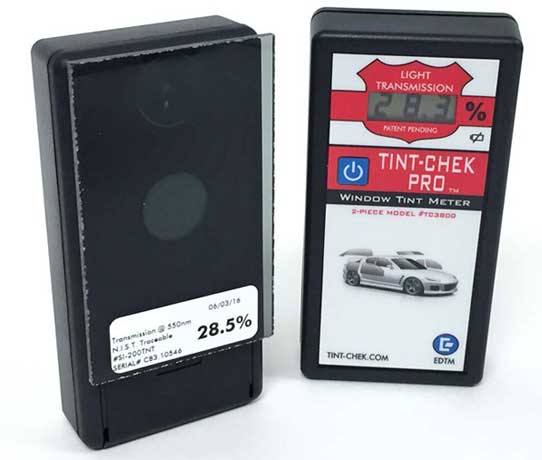
TC3800 Tint-Chek PRO Window Tint Meter
The TC3800 is a two-piece tint tester that checks windshield, rear window, and side window tint. It keeps the backlit display and 0.1% resolution, and adds simple three-step operation and easy battery replacement. It's the most complete option for patrol and traffic units that need to test every piece of glass.
You can see all three side by side on our tint meter category page.
Which Tint Meter Is Best for Your Department?
There's no single best tint meter for every officer. It depends on how you work:
• Mostly side-window checks in daylight: the TC1800 covers the essentials.
• Night patrol or close-to-the-limit readings: the TC2800 adds the backlight and 0.1% resolution.
• Full coverage, including windshields and rear windows: the TC3800 is the one to choose.
Tips for Using a Tint Meter in the Field
• Clean the glass first. Dirt or residue can interfere with the reading.
• Take more than one reading across the window to confirm consistency.
• Verify the meter with the calibration standards that come with it.
• Follow your department's procedures for testing and documentation, and know the VLT limits that apply in your jurisdiction, since they vary by location and window position.
Frequently Asked Questions
What is the best tint meter for police officers?
It depends on the job. The TC1800 and TC2800 are one-piece meters for side windows, while the TC3800 is a two-piece meter that also tests windshields and rear windows. For night work and close readings, choose a backlit model with 0.1% resolution (TC2800 or TC3800).
Can a tint meter work at night?
Yes, with a backlit model. The TC2800 and TC3800 have backlit LCD displays that make readings easy to see in the dark.
Can headlights or cloudy weather affect a tint meter?
They can affect older VLT meters. Tint-Chek meters use patent-pending techniques to remove changing ambient light conditions from the measurement.
Is a car tint meter the same as a tint tester?
Yes. "Car tint meter," "tint tester," and "digital tint meter" are all common names for a handheld device that measures window VLT.
Can a tint meter test a windshield?
A two-piece meter such as the TC3800 can test windshield, rear window, and side window tint. One-piece meters are designed for glass that slides into the opening.
How thick can the glass be?
Tint-Chek meters measure automotive glass and any glass or film up to 1/4" (6.5 mm) thick.
Does the meter come calibrated?
Yes. Every Tint-Chek meter is factory calibrated to a NIST-traceable standard and includes two NIST-traceable calibration standards.
The Bottom Line
The best tint meter for police officers is the one that gives a readable, repeatable result in the conditions you actually work in: at night, in changing light, one-handed, and quickly. Pocket-sized, no-lever designs, ambient light removal, and NIST-traceable calibration are common to the whole Tint-Chek line, while the backlight, 0.1% resolution, and windshield testing separate the models.
Explore the full tint meter lineup and compare the TC1800, TC2800, and TC3800 to find the right fit for your patrol.