

Blog
Is a Tint Meter Reading Enough to Issue a Citation?
Short answer: a verified tint meter reading is the core measurement behind a tint citation, but whether it is enough on its own is a legal question set by your state statute, your agency’s policy, and your prosecutor. A reading is strongest when it is verified, repeated, and documented.
Key Takeaways
• A meter measures visible light transmission (VLT), which is the measurement most tint limits are written around.
• Confirm with your agency and prosecutor what your state requires to support a citation.
• A reading carries more weight when the meter was verified, the test was repeated, and the details were recorded.
• A meter reading does not cover every tint violation: reflectivity and color are separate questions.
What a Tint Meter Reading Tells You
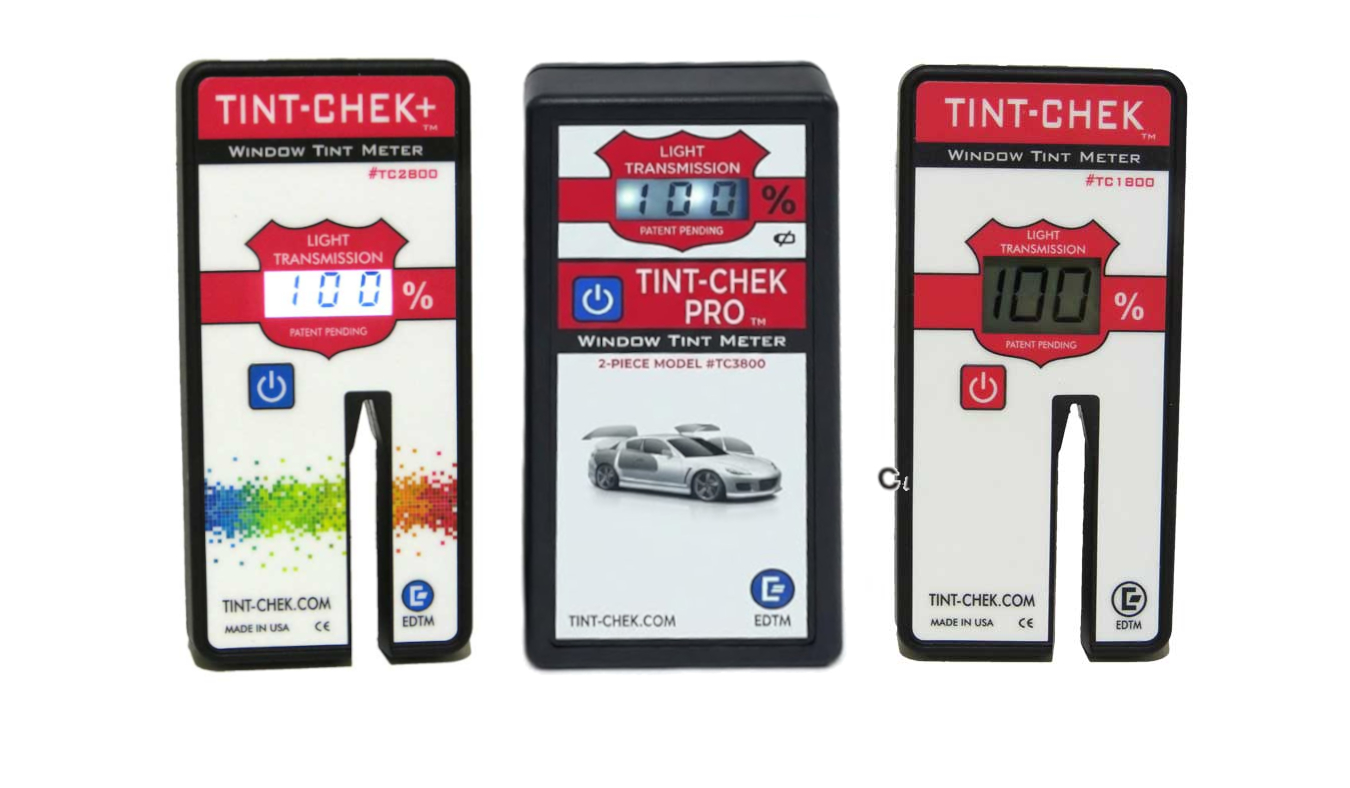
Tint-Chek meters measure the VLT of automotive glass and any glass and film up to 1/4 inch (6.5 mm) thick. In other words, the reading reflects the light that passes through the glass and film together at the spot you measured. For a statute written as a minimum VLT, that is the number you compare with the limit. The question is atint meter reading enough to issue a citation therefore comes down to how defensible that number is.
Why Law and Policy Decide, Not the Meter
A tint meter gives you a measurement. It does not tell you what your state requires to prove a violation. Statutes differ on which windows are regulated, how limits are stated, and what counts as proof. Agencies add their own rules for documentation. Ask your legal advisor or prosecutor what your jurisdiction expects, and follow your department’s procedure.
What Makes a Reading Stronger
|
Element |
How to support it |
|
Verified meter |
Measure the supplied 27% and 59% standards; readings should fall within plus or minus 2% of the indicated values |
|
Clean test |
Clean the glass, wait for 100% at start-up, slide the meter fully onto the glass, and keep the glass perpendicular to the sensor |
|
Repeat reading |
Re-test the window to confirm the first result, as the quick-start directions instruct |
|
Right window |
Record which window you tested and where on the glass |
|
Clear record |
Meter model, readings, time, and your calibration check |
|
Supporting media |
Photos or video where department policy calls for it |
Know the Meter’s Specifications
Tint-Chek meters list an accuracy of plus or minus 2 percentage points and repeatability of 1 percentage point. The TC2800 and TC3800 display to the nearest 0.1%, while the TC1800 displays to the nearest 1%. A reading close to the limit deserves extra care, and your agency should have a position on tolerance. Ask your prosecutor how it is handled in your courts.
What a Meter Reading Does Not Cover
A tint meter measures light transmission. Some states also regulate how reflective film may be, which colors are prohibited, or whether side mirrors are required. Those are separate questions that need separate evidence. If your statute covers them, document them separately from the VLT reading.
A Practical Routine for Roadside Tint Enforcement
This sequence supports roadside tint enforcement that holds up later:
1. Know the statute and limit for the window you are testing.
2. Verify the meter with its standards before your shift and log the result.
3. Take the reading carefully and repeat it.
4. Record the model, readings, window, and conditions right away.
5. Follow agency policy for photos, notes, and report format.
A dependable policetint meter makes this routine easier. Tint-Chek meters are factory calibrated to a NIST traceable standard and ship with two NIST traceable calibration standards.
Common Ways a Reading Gets Challenged
• The meter was not verified, or the check was not recorded
• The glass was dirty, or the meter was tilted
• The test was taken at the extreme edge of the glass, where film coverage may be incomplete
• There was only one reading and no confirming re-test
• The record does not say which window was tested
• The report does not name the meter model
Each of these is preventable with a routine and a template. None of them has anything to do with the tint itself, which is why careful process matters as much as the number.
Questions to Ask Your Prosecutor in Advance
• What evidence do you want in the file for a tint citation?
• How do the courts treat measurement tolerance near the limit?
• Do you want photos or video, and of what?
• How should officers handle factory tint versus aftermarket film?
• Are there statutory elements besides VLT that need separate proof?
Choosing a Meter That Supports Your Record
Meter features can make a record cleaner. The 0.1% resolution of the TC2800 and TC3800 removes rounding, so a window at 39.5% VLT is not shown as 40%. Their backlit displays make results easy to read at night or indoors. The two-piece TC3800 is designed for windshield, rear window, and side window testing, so one meter can cover more windows.
Reasonable Suspicion for the Stop vs. Proof of the Violation
Two separate questions get blended together. One is whether an officer had enough to make the stop. The other is what proves the violation in court. Published decisions show these can be treated differently, and the results vary by jurisdiction and facts:
• A 2025 Wisconsin Court of Appeals decision (State v. Morello) found an officer’s testimony about training and experience sufficient to establish reasonable suspicion for a stop, even without a meter reading at that point.
• A South Carolina Attorney General opinion described court decisions allowing portable tint meters to corroborate a stop, while leaving the question of admissibility to the courts.
These examples illustrate that the answer depends on where you work. They are not legal advice. Your prosecutor or legal advisor can tell you how courts in your jurisdiction handle meter evidence.
Expect Questions About Your Records
When a reading is contested, defense-side questions often turn to the meter’s verification and the officer’s training. Keep your calibration-check log, your training record, and your test notes together so you can answer clearly. Several published agency policies already require training before a meter is used and a log of assigned meters.
Frequently Asked Questions
Can an officer cite for tint without a meter?
That depends on your state law and agency policy. Ask your prosecutor what your jurisdiction accepts.
How accurate is a Tint-Chek meter?
The specification is plus or minus 2 percentage points, with repeatability of 1 percentage point.
Should the reading be repeated?
Yes. The manufacturer’s quick-start directions call for re-testing the window to confirm the first result.
Does the meter measure reflectivity?
No. It measures visible light transmission.
A Reading Is the Start, Not the End
Treat the meter reading as the foundation of the stop and build the rest of the record around it. Explore Tint-Chek meters made for law enforcement and made in the USA.