

Blog
The Complete Guide to Roadside Tint Enforcement Programs for Police Departments
A roadside tint enforcement program is the set of policies, equipment, training,
verification routines, and records that lets a police department measure window
tint consistently and defend the results. This guide explains each building
block of a tint
enforcement program, shows how three published agency policies handle them,
and lists the Tint-Chek meter specifications that matter when you choose
equipment.
Information current as of October 2026. This guide is for law enforcement agencies. It is not legal advice; confirm requirements with your agency’s legal advisor and prosecutor.
Key Facts at a Glance
• A tint enforcement program is a system, not a device: policy, trained operators, a verified meter, documentation, and court preparation all have to work together.
• Tint meters measure visible light transmission (VLT), the percentage of visible light passing through the glass and any film.
• Tint-Chek meters list an accuracy of plus or minus 2 percentage points and repeatability of 1 percentage point, and ship with two NIST traceable calibration standards at approximately 27% and 59% VLT.
• Published agency policies commonly tie meter verification to use: before each use, each day, or each shift.
• Statutes, approval rules for meters, and legal standards for stops differ by state, so every program must be anchored in local law.
What Is a Roadside Tint Enforcement Program?
A roadside tint enforcement program is an agency’s organized approach to checking window tint during traffic enforcement. It covers who may use a meter, which meter they use, how the meter is verified, how a test is performed, what gets recorded, and how the results are presented in court. The meter is the tool. The program is what makes its readings reliable and repeatable across officers and shifts.
One agency states the purpose plainly: its policy directs use of a window tint meter to measure visible light transmittance and enforce state tint law, to improve the quality of tint enforcement and convictions, and to set procedures for certification, maintenance, calibration, and use (Acton Police Department, Policy 5.05).
The Ten Building Blocks of a Tint Enforcement Program
|
Building block |
What it answers |
|
1. Legal foundation |
What does our statute require, and what is our authority for the stop and the test? |
|
2. Written policy |
What are the rules, and who approved them? |
|
3. Equipment |
Which meter do we use, and is it approved where required? |
|
4. Training and certification |
Who is qualified to operate a meter? |
|
5. Calibration and verification |
How do we know the meter is accurate today? |
|
6. Field procedure |
What steps do officers follow at the vehicle? |
|
7. Documentation |
What is recorded, and where? |
|
8. Equipment management |
Who has which meter, and what happens when one fails? |
|
9. Court readiness |
Can we show the meter worked, was verified, and was used by a trained operator? |
|
10. Review and improvement |
How do we audit and update the program? |
1. Start With the Legal Foundation
Everything in the program depends on state law. Window tint limits are written by state and vary by window: windshield, front sides, rear sides, and rear window. States also differ on reflectivity, color, exemptions, and whether and how a meter may be used during a stop. Some states approve specific meters; Florida’s administrative code, for example, requires that meters used by troopers be approved by the Division, and Florida Highway Patrol policy states that no other tint meter is authorized.
Your agency’s legal advisor should answer these questions in writing before the program launches:
• What does the statute say about each window, and is the limit measured on glass and film combined?
• What is required to justify a stop, and what is required to justify using the meter?
• Are there approved-equipment, accuracy, or reference-sample rules in state code?
• How are medical and other exemptions documented?
• How do courts in our jurisdiction treat meter evidence?
For help looking up and verifying limits, see our guide to window tint laws by state.
2. Put the Rules in Writing
A written policy gives every officer the same instructions and gives the agency something to point to if a test is challenged. Our companion guide on how to write a department tint SOP walks through the sections in detail. At minimum, the policy should cover purpose, legal authority, equipment, training, calibration, field procedure, documentation, and equipment accountability.
3. Choose a Law Enforcement Tint Meter
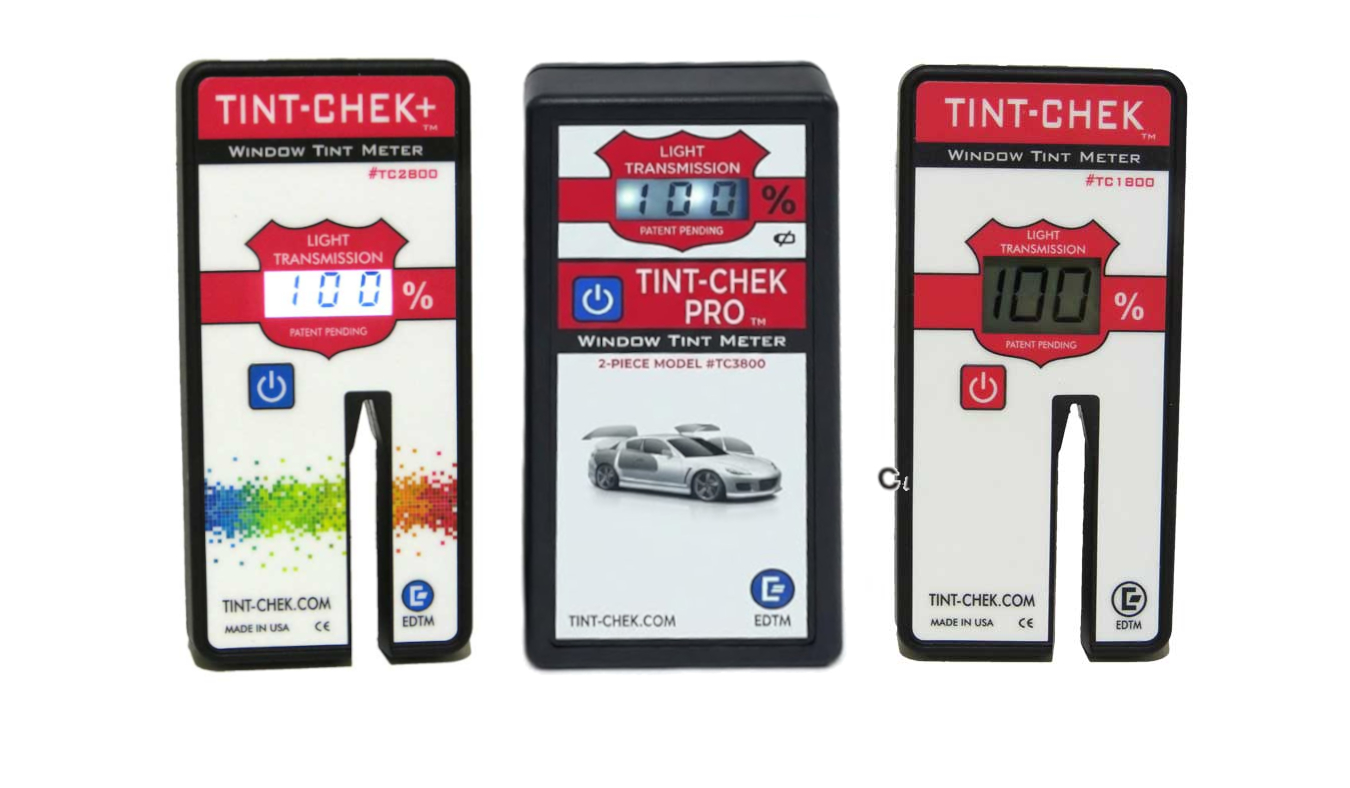
A law enforcement tint meter should match the windows your officers test and the conditions they work in. EDTM’s Tint-Chek line includes three models, all made in the USA and all measuring light transmission at 550 nanometers with an LED light source.
|
Specification |
TC1800 Tint-Chek |
TC2800 Tint-Chek + |
TC3800 Tint-Chek PRO |
|
Design |
One-piece |
One-piece |
Two-piece (reflector and instrument units) |
|
Windows |
Side windows (window lowered) |
Side windows (window lowered) |
Windshield, rear window, and side windows |
|
Resolution |
1% |
0.1% |
0.1% |
|
Display |
Digital |
Digital, back-lit |
Digital, back-lit |
|
Accuracy |
+/- 2 percentage points |
+/- 2 percentage points |
+/- 2 percentage points |
|
Repeatability |
1 percentage point |
1 percentage point |
1 percentage point |
|
Battery |
9V |
9V alkaline |
9V alkaline |
|
Test time |
2 seconds |
2 seconds |
Not listed in the user guide |
|
Dimensions |
5.2 x 2.5 x 1 in. |
5.2 x 2.5 x 1 in. |
5.1 x 2.6 x 2.0 in. |
|
Weight |
0.34 lb |
0.34 lb |
0.78 lb |
|
Sample thickness |
0 to 0.25 in. |
0 to 0.25 in. |
0 to 0.25 in. |
|
Operating temperature |
0 F to 122 F |
0 F to 122 F |
0 F to 122 F |
Higher resolution matters when a reading falls close to a legal limit, because a meter that displays whole numbers rounds the result. A back-lit display helps at night and indoors. A two-piece design such as the TC3800 extends testing to the windshield and rear window.
4. Train and Certify Operators
Published policies treat training as a precondition. Acton’s policy allows only certified operators or instructors to use a meter for enforcement, and it keeps a log of certified instructors with certification and recertification dates. Cleveland’s order requires all sworn members to be trained on the legislation, use, maintenance, and calibration of the tint meter, delivered through the department’s learning management system.
A practical training outline:
1. The statute and the limits that apply to each window
2. How the meter measures light transmission and what the display means
3. The verification routine using the calibration standards
4. The field procedure, step by step, for the meter issued
5. Error messages and what to do about them
6. Documentation and how to testify about the test
7. Hands-on practice on parked vehicles under supervision
5. Verify Calibration on a Schedule
Verification is how an agency shows a meter was accurate when it was used. Tint-Chek meters are factory calibrated to a NIST traceable standard, calibrate themselves at start-up, and include two standards at approximately 27% and 59% VLT. The manufacturer’s instruction is to verify the meter on a regular basis and confirm that it reads within plus or minus 2% of the standards’ indicated values. If it does not, inspect the standards, and if they are in good condition, stop using the meter until calibration is verified or corrected.
The manuals do not set a fixed interval, so the schedule is your agency’s decision. Published policies offer models:
• Acton: operators verify calibration at least once per shift of assignment and use of the instrument, and a meter is not used when calibration is outside the manufacturer’s specifications or the calibration standards have expired.
• Florida Highway Patrol: the meter is tested for accuracy before use on each day it will be used, and the test is recorded on a test log. FHP also states, citing state rules, that reference samples are replaced at least once per year by a qualified laboratory.
• Cleveland: a calibration test is completed before use, and a meter that fails is removed from service until it is properly calibrated.
Check whether your state has rules like Florida’s on reference sample replacement, and read our guide to how often a police tint meter should be calibrated.
6. Standardize the Field Procedure
Consistent technique protects the reading. For the one-piece TC1800 and TC2800, the manufacturer’s quick-start directions are:
1. Roll the window down at least 3 inches.
2. Clean the glass.
3. Turn the meter on; the display reads 100% when it is ready.
4. Slide the meter over the edge of the glass and read the result, keeping the glass perpendicular to the sensor.
5. Re-test the window to confirm the first reading.
For the TC3800, place both units together with no glass between them, turn the instrument on, and wait for 100%. Separate them, place the reflector unit on the inside of the window and push it firmly so the suction cups hold, place the instrument unit on the exterior, and press the power switch to read the VLT. Whether and when an officer may require a window to be lowered or access the interior is a legal and policy question; see do police have to roll down the window to test tint.
7. Document Every Test
Documentation turns a roadside measurement into usable evidence. Florida Highway Patrol directs members to record important information for later court use, such as the meter reading for the violation cited, along with the meter’s serial number and any accuracy tests in the test log. A complete record typically includes:
• Statute and window tested
• Meter model and serial or inventory number
• Date, time, and result of the verification check
• The reading, the confirming re-test, and where on the glass the test was taken
• Any exemption presented
• Photos or video as required by policy
A step-by-step view of building the record is in our guide to building a stronger tint citation.
8. Manage Equipment Like Evidence-Grade Instruments
• Inventory log. Acton logs manufacturer and model, department inventory number, serial number, instrument certification, standards assigned, and the due date for new standards.
• Assigned standards. Acton also requires that calibration standards be assigned to a specific meter and not used for any other instrument.
• Carrying case. Meters and standards should travel and be stored in their cases.
• Failure reporting. Cleveland directs that meters needing service be reported to the officer in charge, and that a log be kept of members assigned a meter.
• Spares. A spare meter keeps enforcement running when one is pulled from service.
• Maintenance. Replace batteries on the low-battery signal, keep the sensing area clean, and respect temperature limits.
9. Prepare for Court
Acton’s policy states that court experience in window tint cases shows personnel must be ready to establish four things: that the meter was operating properly, that it was properly calibrated, that the instrument and standards are certified for accuracy and the standards have not expired, and that the operator is trained and certified. Building a program around those four questions gives every officer a clear checklist. Our article on whether a meter reading is enough to issue a citation explains how the reading fits into the wider evidence.
10. Fairness, Safety, and Review
Fairness
Policies can set limits that protect the public and the agency. Cleveland’s order, for example, states that members shall not stop vehicles solely due to suspicion of a window tint violation, shall use the meter only when there is reasonable suspicion of a violation, and limits tint testing to the front driver and passenger windows. It also addresses exemptions, including a requirement that the driver carry an affidavit signed by an optometrist. Your program should spell out how exemptions are handled; see handling a medical exemption claim.
Officer safety
Training and equipment choices can shorten the time officers spend handling a meter at a vehicle. Plan the test with your safety training; see tint enforcement and officer safety.
Review
Audit the program on a schedule. Useful measures include verification-log completeness, training currency, equipment downtime, and the outcomes of contested cases. These are suggested measures, not requirements.
A Sample Rollout Timeline
|
Phase |
Activities |
|
Phase 1: Foundation |
Legal review; confirm statutes and any meter approval rules; draft policy |
|
Phase 2: Equipment |
Select and purchase meters; set up inventory log; assign calibration standards |
|
Phase 3: Training |
Train and certify instructors, then operators; document completion |
|
Phase 4: Pilot |
Run on selected shifts; collect feedback and verification logs |
|
Phase 5: Full rollout |
Issue policy to all operators; begin routine audits |
|
Phase 6: Review |
Evaluate results; update policy and training |
Common Failure Points
• Meters verified but no record kept
• Operators who were never trained or whose training is not documented
• Calibration standards that are scratched, expired, or shared between meters
• Policies that copy another agency’s rules without checking local law
• No procedure for a meter that fails or shows an error
• Reports that omit the meter model, the window tested, or the verification
Frequently Asked Questions
What is a roadside tint enforcement program?
It is an agency’s system for measuring window tint during enforcement: written policy, approved equipment, trained operators, verification routines, documentation, and court preparation.
What does a law enforcement tint meter measure?
Visible light transmission, the percentage of visible light that passes through the glass and any film.
How accurate are Tint-Chek meters?
They list an accuracy of plus or minus 2 percentage points and repeatability of 1 percentage point.
How often should meters be verified?
The manufacturer says on a regular basis and does not set a fixed interval. Published agency policies tie the check to use, such as once per shift or before each day of use.
Do all states require approved meters?
No. Some do, so check your state’s rules before purchase.
Which Tint-Chek model fits which windows?
The TC1800 and TC2800 are one-piece meters for side windows. The two-piece TC3800 is designed for windshield, rear window, and side window testing.
Build the Program Around the Evidence
A defensible roadside tint enforcement program rests on written policy, trained operators, verified meters, and records. Explore the Tint-Chek law enforcement tint meter lineup to equip your officers with instruments designed for the job.
Sources and References
• Acton (Massachusetts) Police Department, Policy & Procedure 5.05, Motor Vehicle Window Tint Meter (effective October 10, 2018): https://actonma.gov/DocumentCenter/View/10990/505-Motor-Vehicle-Window-Tint-Meter
• Florida Highway Patrol, Policy 17.27, Use of Tint Meters (revised June 16, 2021): https://www.flhsmv.gov/pdf/fhp/policies/1727.pdf
• Cleveland Division of Police, General Police Order 4.06.18, Window Tint Meters (effective August 11, 2025): https://www.clevelandohio.gov/sites/clevelandohio/files/Public%20Safety/Police/4.06.18%20WINDOW%20TINT%20METERS.pdf
• EDTM Tint-Chek TC1800, TC2800, and TC3800 user manuals (specifications, quick-start directions, calibration standards, warranty)
• Acton, Florida Highway Patrol, and Cleveland documents are public policies of those agencies and may use different meter models; they are cited as examples of program design, not as endorsements.